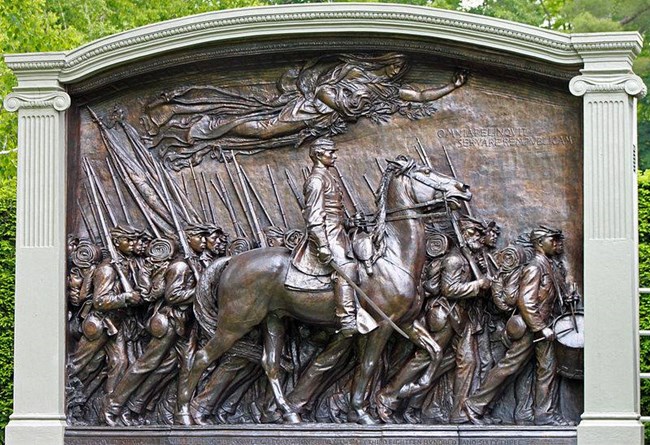
PART 1: Read this brief synopsis of COL Robert Gould Shaw’s Union Regiment’s actions at Fort Wagner. You might remember the scene as depicted in the popular 1989 movie Glory. The picture above displays a monument that represents (course theme alert!) this battle. What observations can you make about the narrative this memorial might put forth regarding Shaw and his regiment?
PART 2: Next, read Robert Lowell’s Poem “For the Union Dead” on page 1664 of your Norton Poetry Anthology. How does this poem address/represent the same monument in the poem?
PART 3: Now read the Kevin Walker Poetry selections located under the “Supplemental Materials” tab. How does your reading of Walker’s poem now engage (disrupt, enhance, undermine, enhance, parody, address, extend, etc.) the messages intended by Lowell’s Poem?
PART 4: Finally, How do Young’s other poems contextualize your understanding of “For the Confederate Dead”?
200-250 words each part; worth 20 instructor points for thoughtful responses. Due NLT Lesson 8 (3/4 FEB). **Please submit all parts as one reply** Thanks.
 en102.art.blog
1. This memorial depicts Col. Shaw departing Boston with the 54th. This monument was erected after his death to commemorate the significance of this event. This was a notable example of colored troops acting in the capacity as citizen-soldiers, fulfilling their duty during wartime, and proving those who questioned their abilities wrong. The monument physically depicts Col. Shaw in the foreground, leading a column of men flowing to his left. Above them is a female figure, probably a representative of liberty, freedom, or another American virtue, going South with the Regiment, maybe a symbol of providence being on their side. This monument creates a very clear narrative. It portrays the 54th as a unit of great significance, setting forth to accomplish a noble task. It portrays Col. Shaw as a brave and courageous man who was willing to take command of a controversial unit and lead them into combat. The monument makes the unit look strong and prepared. This is clear as Col. Shaw has his saber already drawn, which is important, because the artist could have just had him holding the reigns, but he consciously chose to depict him with his weapon at the ready, even though he is just leaving Boston. Additionally, the men all have their weapons shouldered, and the drummer boys appear to beating out a tune.
2. This is a poem set in Boston, the city from which Colonel Shaw set out from with the 54th Infantry. The poem discusses the monument and Colonel Shaw a fair amount. It talks about his monument in relation to the construction the author is witnessing. The author says that William James could “almost hear the bronze Negroes breathe.” Mr. James was a professor in Boston, but this is a testament to Augustus Saint-Gaudens detail and craftsmanship on this monument. The author addresses that the Regiment took heavy casualties soon after leaving Boston, which is true. The monument is compared via simile to a fishbone, as if it is somehow stuck unwillingly in the city. The author goes on to discuss the appearance of Col. Shaw himself. It talks about not just his physical appearance but his personality and the freedom that death has brought him. It then transitions to talking about the Civil War as a whole and then moves back into the present. The monument is certainly addressed as being significant in history of the city.
3. Mr. Young’s work is harder to follow then Mr. Lowell’s, largely because of how it is organized. Mr. Lowell’s jumps from present to past to the present, while Mr. Young’s seems to just be an observer commenting on the past. I think the messages of these two works pair together decently. Mr. Young’s work praises the 54th Regiment for its role in the Civil War, and its place in the history of Boston. Mr. Lowell’s work looks more at the South’s past and uses allusions, simile and metaphor to create imagery regarding its past. The two works almost run parallel to each other. One doesn’t really disrupt or support the other any significant amount. Mr. Young’s work pays homage to the Confederate dead while also remembering the institution of slavery. This contrasts to the other work which focuses on a black infantry regiment headed South to engage the Confederate Army. It provides me a better frame of reference certainly, but besides that, it doesn’t inhibit my understanding or interpretation of the works.
4. I wasn’t sure of much of Mr. Young, but upon reading his other works several sames became clear. He discussed living in the Midwest and how he wanted all of these various components of this lifestyle. He mentioned that he desired to be the only black person he knew. Why this is I am not sure, but it certainly contextualized his work about Confederate Dead. He discusses being in a barber shop and makes many references that indicate to me he may have lived in the inner city of a large city at some point. These are reinforced by this next work called the “Bling Bling Blues”, which further reinforce this through his diction. These works though are both unique, but they are tied together as portrayls of his experiences. The ode to the Confederate Dead is somewhat contextualized by understanding that he may have grown up in black family, whose ancestors may have been effected by the institution of slavery. His work though, may be about more than just White Confederates but also Black ones. This may play a role in driving his ode to the Confederate soldiers, many of whom he calls “draftees”. These ideas though, are fairly stand alone, and don’t reoccur in any of his other works. His personality seems different, certainly more upbeat in the other three works. He seems solemn and respectful in the work regarding Confederates.
LikeLike
Some good analysis and observations from the poetry, Nick; I’m not sure I see as much homage to the Confederates here as you did, though I suppose there could be a hint of an empathetic (or at least indifferent) tone for the soldiers in their compulsory compliance of the “lost cause,” as southern Reconstruction revisionists have called it in the past. Lowell’s poem seems to highlight the shame of civil complacency as time has moved forward while the Shaw memorial seems a distraction to the urban decay–a bi-product of urban progress. This notion of industrial or commercial progress is juxtaposed with the ideological progress that the memorial represented to civil rights. The similarities in Young’s poem extend this idea of apathy in the way that the daily humdrum (checking the fridge, watching TV) moves on around a monument that actually commemorates a reflection of the mural of slaves bending to “pick the endless white,” a mural that could only be seen by few, such as the likes of a child indicated by lines 22-24. The invisibility of this mural to most is a symbol of the same complacency that only an inquisitive, untainted, less distracted mind would notice. Later (and earlier) allusions to the weather maps (57-60) and their imaginary lines, and the way the word “Race” is enjambed (line 63) so as to focus attention on the racial lines that also remain invisible against the “almost rain” help us understand that the poet’s frustration is rooted in the civil rights movement’s failure to truly undo the endless oppression that is allowed to happen “under the radar,” to borrow Young’s weather metaphor. This senseless perpetuation now gives clear meaning to his earlier lines that “…In my fridge only/ the milk makes sense–/expires” (6-8).
I can agree with your assessment that black culture has indeed had an effect on his viewpoints, but I think “Bling Bling Blues” may be more of a subtle cautionary to be on guard lest a desire for excess get in the way of remaining “hungry” for freedom and institutional change. The poet may even be satirizing himself to some degree as a reminder against turning a blind eye to the strife that still exists and could return if one doesn’t keep watch–or to “stay woke,” if I may use a popular contemporary vernacular. Thanks for the comment.
LikeLike
This memorial of Shaw and his regiment shows a display of bravery under adversity however if one did not know the context of the battle or the memorial it would merely look like troops marching. The memorial paints a picture of Shaw maintaining his cool whilst marching upon Fort Wagner, his soldiers look disciplined and calm as well. It paints a very great picture of leadership. Interestingly there is what appears to be an angel flying over them looking down upon them. This could represent the battle that was to be followed after marching where 1,500 Union soldiers were lost or it could represent them being blessed by the divine. Either way I think the memorial does a great job at showing their bravery at what seems like an impossible task and the ability of soldiers to withstand an enormous amount of suffering and fear. The poem opens up another side to the monument and how “Their monument sticks like a fishbone in the city’s throat.” Criticizing how the city is every expanding and looks upon its history with distastefulness as it builds parking garages and aquariums. It also provides a different perspective on Col. Shaw describing him with “He has an angry wrenlike vigilance, a greyhound’s gentle tautness; he seems to wince a pleasure, and suffocate for privacy.” This then later connects to a later statement the poem makes proclaiming that Shaw’s father did not want the monument because it was hypocritical that they build a monument for them (the African American regiment) after throwing their bodies in ditches and not burying them properly. However the best line within the poem is “The stone statues of the abstract Union Soldier grow slimmer and younger each year–wasp-waisted, they doze over muskets and muse through their sideburns…” Which I also think is the poet taking further criticism at how the city seems to have forgotten or look down upon this memorial as it expands yet the other memorials for other soldiers and officers are well taken care of and symbolize victory in some way or another. Yet this memorial is a victory for Col. Shaw in showing the world different even though it costed him his life. Young’s poem “For the Confederate Dead” provides a different point of view it is interesting how he starts off with the Weather man and how he cannot trust him and that he can only trust what is certain like the expiration date on his milk. He then goes into talking about the history of the south with pictures, paintings, and memorials of their past with slavery and slaves picking cotton, being whipped like horses, and so forth. Towards the end he describes how battles never go down how they are depicted instead soldiers flee for their lives gravely wounded into the tree lines waiting for the bayonet of the enemy to take their final breath. It seems like a tragedy and it is sad. His next poem Ode to the Midwest is more comical describing how the “Midwest” perfection is to be “doused in cheese and fried” continuing on with “supermarket stocked high as cholesterol.” and he goes on to write about the odd things in our society that are so contradictory. His other poems honestly help point out how contradictory war is and how this endless pursuit of freedom and life is for what to consume ourselves to death with deep fried cheese, driving cars two blocks down the road instead of walking, live in markets stocked with cholesterol and fate or to chase money and complain about not having enough wallet space to store it all. To chase luxury at the expenditure of past loss of life that gave us the opportunity to do so. Young’s poems do a great job at pointing out the inconsistencies our society has with our proclamations of pursuit of liberty, life and happiness and how we have things that restrict some liberties and we chase things that end life that all we care about is short term happiness and have no thought of the consequences or past sacrifices that were taken to provide this for us. I feel there is much more that can be learned by looking at analysis’s of these poems that could provide me with a different perspective as well, I find these poems interesting and the mixed context with the Civil War and present day society to be quite intuitive.
LikeLike
The memorial seems to represent Shaw’s Regiment in a way that is meant to honor and glorify the group of soldiers. On a very basic level, the monument shows the uniformity and discipline of the troops, as they march along in the stereotypical Civil-War style formation. Their faces show no emotion, rather they seemed entirely focused on whatever task lies before them. The color of the monument is also interesting, as the bronze tone depicts the black soldiers as the same color as their white officer, seeming to highlight the unity across races that the unit developed, and the lack of importance for such differences. In addition, it seems that some goddess flies overhead the regiment, blessing them with her graces. Based on American history and the female figures that were used to represent other actions (think Manifest Destiny), this goddess could represent liberty, freedom, or victory. Her inclusion implies the idea of a divine intervention in the case of Shaw’s Regiment, and that perhaps his unit’s example was an intentional move toward equality by God. In other words, the Regiment was blessed by God in order to prove the equality between blacks and whites, especially during a time as divided as the Civil War. In total, the monument represents the determination of Shaw’s Regiment and the profound impact their actions had on society.
Robert Lowell’s Poem “For the Union Dead seems to be an increasingly depressing and downtrodden observation of Boston, the United States, and the world as a whole. His imagery of the city is bleak, painting Boston as some kind of ghost town. Despite his observations on the city as a whole, no people appear in his poem, only cars, construction vehicles, buildings, and machines. When he turns his attention onto the monument, this depressing and cynical tone loses none of its bitterness. It describes the black soldiers of the monument as if they were the standing ghosts of those same soldiers who died all those years ago. The initial focus on the Colonel is to describe his frail, thin nature, and how this nature represents the monument being an uncomfortable thorn in the side of the city. The Colonel described by Lowell is not a majestic leader, but one who relishes in death and flinches at life, a crazy, grim-reaper style of character. Or, if the Colonel is not crazy, his obsession with death only adds to the poem’s depressive nature. Finally, the poem’s focus on Shaw’s father finishes out the story, as Lowell focuses on the irony associated with Shaw’s father’s use of a racial slur when describing the soldiers his son died among. In total, the poem represents the monument in a much less glorious and much more depressed manner than a simple viewing of the monument would produce.
Kevin Young’s poem “For the Confederate Dead” seems to enhance, address, and extend the messages presented by Robert Lowell in his poem “For the Union Dead”. It matches Lowell’s own depressive tone, and focuses on the city of Boston, unappreciated beauty, the irony of the monument, and the true nature of the Civil War. For example, it seems that Young recognizes and intentionally alludes to Lowell’s own poem many times throughout his own. The title, references to his middle name being Lowell, and the description of Colonel Shaw all represent similarities between the two poems. Young produces the rest of his poem to exist almost as a supplement to Lowell’s. The titles imply that they should be opposites, after all, they are the same except for one word “Union” and “Confederate”. However, the similarity between the two poems is strikingly obvious. Both authors seem to hold a deep disillusion to the time period and events that occurred in the Civil War. Young’s focus on the contrast between the monument of black soldiers and the mural of slave labor extends Lowell’s focus on the irony and incredulous nature of Boston’s reaction to the war. They both seem to believe that America has forgotten how cruel the world was, an idea initiated by Lowell and further explored by Young in two dreary poems about a Civil War Monument.
Kevin Young’s other poems contextualize “For the Confederate Dead” by providing an important background on Kevin Young, illustrating other styles of writing that he utilizes, and demonstrating what he wishes to focus on and emphasize in his poems. For example, based on his poems, Kevin Young seems to be a black man from the Midwest, where he witnessed conflicting cultures and environments, with everything ranging from small town areas to success stories dealing with millions of dollars. It seems as though each poem that Young writes is fundamentally different, both in tone and structure. His poem on the Midwest is read as a single block of words, while the Barber Shop poem cuts off in the middle of each poem, and “Bling Bling Blues” reads almost as jazz or rap. Ultimately, understanding how Young changes each poem based on his subject material helps to contextualize “For the Confederate Dead”. In Young’s poems, structure and tone seem to be infinitely more important than the words he uses in his poems. Following along this train of thought, the somber tone and deconstructed, illogical structure of the poem demonstrate Young’s sadness, confusion, and frustration with the monument of black soldiers and with America’s perception of the Civil War as a whole.
LikeLike
1. The monument is a display of the soldiers of the 54th Massachusetts Infantry marching off to fight at the Assault of Battery Wagner. There are many faces and character depicted in the monument. Notably, there is Colonel Robert Gould Shaw on his horse with his saber drawn and leading the rest of the soldiers to battle. This could be to symbolize his dedication to the 54th Massachusetts Infantry, as he trained them up to be an effective African American fighting force, despite facing discrimination from others because of their race. Additionally, it shows that he was a leader that went along with his troops, since he is alongside them, not giving them orders from the rear. The monument also displays the faces of the soldiers in detail. Each person has been uniquely crafted, indicating that each person has a story to be told. Additionally, among the soldiers there is both young and old. The drummer boy at the front is smaller and appears to have a younger face. Directly behind him is an older bearded man. As you look at the rest of the faces in the monument, you can see that each has a determined look, despite age or facial features. This symbolizes the fighting spirit of the 54th Massachusetts, who proved their strength at the Assault of Battery Wagner, and demonstrated that strength of African American soldiers.
2. The poem “For the union Dead” discusses many topics and seems to jump back and forth in time. Notably, it discusses a lot about racial discrimination and segregation. Included in this, is the monument for Colonel Robert Gould Shaw and the 54th Massachusetts Infantry. Robert Lowell indicates how important that regiment is to Boston. He says, “Their monument sticks like a fishbone in the city’s throat”. This simile shows the importance of the soldiers, despite their race. A fishbone stuck in the throat is hard to get out, and uncomfortable. Since this poem was written in the 1960s, when Civil Rights Movement was going on, it could be implying that this monument sticks out in the city of Boston, where a lot of people see it and recognize it, but may feel uncomfortable by it because of what it represents. Lowell continues on to describe how Col. Shaw physically looks, and how he imagines his personality to be like. Finally, as the poem starts to transition from talking about the Civil War, it quickly references the monument one last time referring to the Shaw’s father not wanting the monument, but instead wanted to emphasize that Shaw died with those he lead in battle, and was buried with them as well. Overall, the poem references the monument and the soldiers behind it in great detail, going into personal details about Col. Shaw and the soldiers of the 54th Infantry.
3. Kevin Young’s poem “For the Confederate Dead” seems to enhance Robert Lowell’s poem “For the Union Dead”. Upon first glance of the title, it is easy to mistake the poem to be a contradictory of Lowell’s poem, but after reading the poem, it begins to show that Young’s poem compliments the meaning of Lowell’s poem. Young’s poem seems to refer to Lowell’s poem on many occasions, first with the title, in which he uses the word “Confederate” instead of “Union”. This could be since Young’s poem is more focused on the Southern states instead of Boston Massachusetts. Young also has a line in his poem saying that “My middle name is Lowell” and then he goes on to say “from my table across from the Confederate Monument to the Dead… a plaque declares war – not Civil”. These lines from Young’s poem references Lowell’s poem, which has a center focus on the monument of the 54th Massachusetts Infantry. Young’s poem almost seems to mock the idea of the monument, but it can be inferred that it isn’t mockery but respect, as it is hinting at the sacrifice of all the people who fought in the war. Finally, young’s poem references the life of slaves, who are in the fields picking cotton and driven on like slaves. He then goes on to talk about the war, where many hide and desert, or die by a bayonet as they try to run through the trees. This is a much different take than Lowell’s poem, but still provides a unique insight to Lowell through the contrasting nature of describing the different positions of the African Americans.
4. Young’s other poems provide insights to his background and can help to better understand what he means in his poem “For the Confederate Dead”. His other poems show that Young is a black man from the Midwest, who has had a luxurious life. He talks about going from rags to riches in his poem “Bling Bling Blues” which has a blues song style feel to it. It goes through a story about the speaker going from hungry to abundantly wealthy. His other poems show difference in cultures that may have conflicted in the way he was raised. However, all this comes together to show deeper meaning to his poem “For the Confederate Dead”. After reading his other poems, it becomes clear that his tone in the first poem is much more somber than it is in his other poems. This contrast not only illustrates how important this poem may be to Young, but also how important he feels the topic is to others. His other poems, which have a lot of ties to ambition, don’t touch on the intricate details of war or grief, while “For the Confederate Dead” hits it on the head. It talks about how he feels about the war, and that he feels that wars in general are pointless and ultimate result in the breathing lying dead or retreating only to be stabbed as they run away. Ultimately, the combination of the other poems by Kennedy young enhances the understanding and meaning of his poem “For the Confederate Dead”.
LikeLike
1. The memorial depicts COL Shaw bravely marching his forces into a battle. This monument depicts Shaw as a leader who led his troops beside them, not behind them. This is important because even though Shaw was leading a troop of all African American soldiers, he felt that they were of equal status to him and important enough to ride along side them and risk his life the same amount his troops were. The soldiers faces are created in great detail, exaggerating each soldiers uniqueness. I think this is an important point to the monument because it shows that even though there were people of different age, social status and physical ability, they all united as one troop to fight for what they believed in. I thought that the angel flying over top of the soldiers was also an interesting depiction because it shows that someone was watching over these troops and blessing their attack. Even though COL Shaw and his troops eventually lost, the angel shows that someone was watching over them and watching out for their well being. COL Shaw looks very calm, collected and ready as he takes his troops into the battle. This shows how confident he was as a leader and how much he trusted his troops.
2. The poem that Lowell writes is interesting because it discusses the creation and dedication of the monument. It seems that although the monument had great historical significance as it was honoring an all African American force, it was not liked by the people in the city. Lowell writes that the construction “on St. Gaudens’ shaking Civil War relief/propped up by a plank splint against the garage’s earthquake,” which leads me to believe that the construction of this monument is threatening the city somehow and because of it’s construction, the city will collapse. Lowell also states that the monument “sticks like a fishbone/in the city’s throat” which leads me to believe that the people in the city did not like the monument. However, then Lowell goes on to discuss COL Shaw and describes him as a brave, loyal, moral man who lead his troops into danger for the betterment of society. This sharp turn in the mood and tone of the poem leads me to believe that although Lowell believes that the city does not appreciate the monument, the monument is depicting an important event and person who should be remembered and recognized. I believe that Lowell is unhappy with the passive way that people are looking at this monument and the construction of this monument and he is trying to tell people that there is a history associated with the monument and the people in it need to be recognized and remembered rather than looked at like an inconvenience.
3. I believe that Kevin Young’s “For the Confederate Dead” enhances Lowell’s “For the Union Dead.” Both poems discuss the disillusions that occurred during and after the civil war. In Young’s poem, the hardships that the soldiers faced was prominent, and their will and determination was even more prominent. Young’s poem references the lives of slaves and how they picked cotton all day long and were still severely mistreated by their owners. By comparing this to the hardships that the soldiers faced and showing how the African American soldiers were able to continue fighting throughout the war and they had the determination to overcome these hardships shows how much their mistreatment as slaves affected them. In the same way, Lowell’s poem calls society to question and think about how they are forgetting the lives of the soldiers that fought a war for them and how these people need to be remembered for their actions. Though Lowell’s title has “Union” in it and Young’s has “confederate,” making it seem like these poems should contradict each other, they very well support each other and remind Americans that no matter what side the soldier fought on, they went through some tough hardship fighting for their sons and daughters, and that should not be forgotten.
4. Young’s other poems seem to compliment “For the Confederate Dead” in the way that the way of thinking is the same. Young talks about life in the Midwest and everything he says seems to contradict itself because in one line he says he wants to die, then he wants to live, he wants to run, but then he wants to walk, which reminded me of “For the Confederate Dead” because in that poem, he compared the lives of slaves and the lives of soldiers. Through his diction, he pointed out the pros and cons of being a slave and a soldier and in the same way in “Ode to the Midwest” Young is comparing things once again. This helped me realize the type of writer Young is and how he likes to write his poems and the way they should be interpreted. In his poem “Bling Bling Blues” Young is discussing the American dream and stating that although the subject of the poem seems to have everything– money, cars, jewelry– the person is still fearful of what they could lose and how hunger and being poor is just one step away. I thought that this tied in nicely with his poem “For the Confederate Dead” because I imagine this is how the soldiers fighting in the war thought. Even if they won a battle or they seemed to be winning the war and the war was leaning in their favor, losing the war was just a step away and so the soldiers always had to be on their toes worrying about the outcome of the war and what would happen next.
LikeLike
PART 1: When looking at the memorial of Colonel Shaw and the 54th Massachusetts Infantry Regiment the first thing I see is one man on a horse and a bunch of men walking on foot. This difference demonstrates, to me at least, who is in charge; the man on the horse is the leader of the men he is marching with. The next observation that I notice is that Colonel Shaw, the man on the horse, is right there in the thick of it with his men. He is not falling back leading from behind to stay protected, he is leading from the front, wherever his men go he goes. This speaks to why this African American Regiment was so success for and had such a good reputation despite their failure at Fort Wagner. These men followed their leader and not juts because he was a good man but because he assimilated with hem. Shaw ignored race, status, and rank (my interpretation of monument of reading) he saw every single one of his men as humans, not just soldiers. The last observation aside from Shaw and his position among the men, we see that the men are walking forward. This may be a stretch but to me this signifies that they have no fear, they will always keep going. This is in part to Shaw and his leadership but also relates to the men and their values.
PART 2: Robert Lowell’s Poem “For the Union Dead” addresses the same monument as part one in a multitude of ways. First is refers to “Colonel Shaw/ and his bell-cheeked Negro Infantry,” this is important in establishing the statue because it provides the reader with who the speaker is talking about. He then mentioned how “their monument sticks like a fish bone in the city’s throat,” meaning Boston could never forget this regiment; while also telling the reading the what, Colonel Shaw’s monument. We also know that this poem is talking about the same battle that is depicted in the monument because it says “Shaw’s father wanted no monument/ except the ditch, / where his son’s body was thrown / and lost with his” soldiers. After reading the brief synopsis on the battle at Fort Wagner and Colonel Shaw’s 54th Infantry Regiment, we know that the battle ended with the capture or death of 1500 Union men, and apparently that number included Shaw. I briefly stated it above, but this poem not only describes the same situation as the monument, but it also addresses the monument and its importance. While it is not a proper gravestone, it serves as a reminder of Shaw and his men, who gallantly attacked a confederate base in Charleston, South Carolina. This poem lets the reader know that this monument in more than juts a monument but a part of history that remains as the rest of Boston is made into parking spaces.
PART 3: There was no Poem by Kevin Walker, so I used Kevin Young’s “For the Confederate Dead” because it parallel what we had been discussing. Young seems to be more figurative than Lowell is. After reading Young’s poems it is as if he is bouncing all over the place, there is definitely a connection between the weather and the war and slaves, but it not as apparent as the connections made by Lowell in his poem. In Lowell’s poem it is clear what he is talking about, he is referring to the monument and its importance to Boston. In Young’s poem it is clear he is talking about a monument, but I do not believe it is the same one, in fact, I believe it depicts a scene of slavery or maybe draftees fleeing a battle as he briefly mentioned in his poem. Additionally, it seems as if Young is angry, the words he used and the way he describes the effects of the war are not done in the manner of someone who is happy. He describes slavery, deserted hotels and overall desolation. All the negativity and confusion of Young’s poem not only encouraged me to think, but it also made my understanding of Lowell’s poem grow tremendously. The complexity of Young’s poem makes Lowell’s poem seem clear and concise and this fosters a deeper understanding of what Lowell is discussing, Colonel Shaw and his legacy.
PART 4: Young’s other poems contextualize my understanding of “For the Confederate Dead” because they provide insight into who Young is as a writer. By reading and thinking about the other poems I was able to see parallels between the tone and way in which Young Writes. In “For the Confederate Dead” Young pains a picture of darkness that ordinarily is off putting, but after reading his other poems I now realize that the dark cynical nature in which he writes is for a purpose. Young is so dark because I believe he used the darkness created to tell the story of someone or something that is important, for example in “For the Confederate Dead” he says “stripping hundred years (at least) of paint and plaster.” Originally I just thought that this was an added detail that showed the deserted hotel was gross and needed a renovation, but after reading the other pieces I am not confident in stating that the physical stripping of pain and plaster is also a representation of the removal of the past and the cruelty of the south, especially towards African Americans which I learned Young was in one of his poems. Therefore, reading Young’s other poems allowed me to have a more enhanced understanding of the true message behind the original poem.
LikeLike
This memorial seems to be depicting COL Shaw as the main hero of the story, leading the rest of the regiment. Shaw is placed in front of the rest of his soldiers, in relation to the observer, and is the only person on a horse. On the horse, Shaw sits completely upright and leads his troops into battle. Shaw is made out to be the most important figure as he is elevated above the rest of the soldiers, showing his prominence.While a huge effect of the battle was proving that African Americans could hold their own in battle, the white man who led those African Americans is still given the majority of fame in this image. This memorial definitely puts more of a focus on Colonel Shaw than the whole of the 54th Massachusetts Infantry. The memorial also seems to claim that Shaw and the 54th are doing the work of God. At the top of the memorial, a woman flies above the marching troops while looking down at them. This woman seems to be an angel sent to protect these soldiers as if they are serving some divine purpose. The memorial clearly puts Shaw and the 54th in a positive light as they are depicted to have the blessing of God and one of His angels as they march on the upcoming battle.
In “For the Union Dead,” Robert Lowell addresses the monument as an important part of history that will not be removed, even as the city of Boston continues to change and develop almost 70 years after the monument’s opening. As Lowell describes the new developments in the city, such as parking garages, he mentions that the monument “sticks like a fishbone in the city’s throat.” A fishbone can be extremely difficult to dislodge from the throat, and at the height of the civil rights movement in 1964, Lowell recognizes that there are likely many who would like to remove the monument and get rid of the thing that has been stuck in the city’s throat for so long. However, Lowell believes the monument is too important to dislodge, and proves this through the absence of others. He states that “there are no statues for the last war [in Boston].” If there were other monuments, then the importance of the one to the 54th would have diminished. By pointing out that this monument is the most recent war monument, even after the two World Wars, Lowell presents the importance of the monument to the city.
In his poem “For the Confederate Dead,” Kevin Young extends the thoughts of Lowell in “For the Union Dead,” commenting on how the memorials in his town are also cemented into the history of the city and will be difficult to remove as he and others struggle to force change in the city. Young notes how the mural is “below sea- and eye-level” at the “heighth of a child.” The lowered height of the poem suggests that it is embedded in the groundwork of the society, almost as a base. It is not seen at eye level anymore because the people are so used to it, and instead it is pushed on to the children of the town, who will grow up thinking the mural is normal and then have no reaction to it later in life, just as the currents adult lack any response now. However, Young expresses the desire to go after this and change the society and uproot the values and ideas suggested by the mural.Young makes a call to be “digging beside the monument (that giant anchor)” and join him in the movement to fight for societal change. While Lowell notes the importance of keeping the monument in Boston upright, Young is hoping to accomplish the opposite.
Young’s other poems all give insight into his life and explain his reasons for wanting to remove the mural, and the ideas anchored in it, from the city and society he lives in. Young’s “Ode to the Midwest” notes many of the desires of the speaker, specifically about being immersed in the American Midwest, and “[wanting] to be the only black person [he knows].” However, when he tried “jumping in [the river],” he “found it frozen.” This is likely representing some resistance by those in the Midwest wanting to keep Young away from their society. This whole poem details Young’s desires and how the racism of people can keep him from them. However, “Bling Bling Blues” shows the disappointment that can come from achieving such desires. Young reveals how even though he has acquired such wealth and fortune, “danger [still] taps [him] on the shoulder wanting to cut in.” This disappointment could relate to Young’s experiences trying to “dig” up the monument mentioned in “For the Confederate Dead.” Even though Young has amassed some fortune through his writing, he still experiences the struggles related to the imagery on the mural, and he cannot be fully satisfied with his position in life while those struggles are still present.
LikeLike
. This monument serves as a glorification of the bravery of Col. Shaw and his troops. They are depicted as being in an ordered formation and marching forward with not a single soldier looking back or showing any indication of fear as they march into a losing battle. Above the men, there appears to be Columbia or the personification of American ideals and dreams. She is following the men into battle which stands to serve as a symbol for how those men are carrying the American dream with them and that the spirit of American liberty is at their backs pushing them forward into the gunfire. Col. Shaw is leading the men with his saber drawn, ready for battle and the drummer appears to be already playing a beat. Both of these details indicate that the men are ready for a fight and the bravery of the men. This monument serves as a memorial of the bravery of not just the 54th but for the bravery of all the black troops who likewise served their country during the civil war as the bravery of the 54th served to show their nation that black troops could be valiant and battle-worthy.
2. Robert Lowel in his poem “for the union dead” laments the state of Boston and how the mon of the Col. Shaw and his men are remembered. He begins his poem by telling of the dilapidated south Boston aquarium and how it is further falling down. He describes the structure as standing in a Sahara of snow. The desert imagery stands to reinforce the idea of the dilapidation of the structure and possibly society as a whole. He then continues and describes the construction around the structure. He describes the “underworld garage” being constructed which stands as a contrast to the collapsing aquarium as it shows that the society is still marching forward an building new structures around its collapsing ones. Only after he demonstrates an example of society moving on does he talk about how the monument of COl. Shaw and his men “sticks like a fishbone in the city’s throat”. The society keeps moving forward but it has trouble reconciling with what the monument means and moving forward. He tells of how his father wanted no monument and the racial attitude of his father which stands to show the attitudes of those at Shaw’s time and even some today that Shaw challenged by showing the bravery of his black troops. And it is because of those attitudes that the monument must stand as a fishbone in the city’s throat until Shaw gets his “blessèd break.”
3. In his poem “For the Confederate Dead” Kevin Young laments those who died in the civil war but ha also acknowledges the injustice of slavery and the senselessness of the conflict and the bloodshed. He demonstrates how many people make the Civil war more appealing by only acknowledging the bravery of the soldiers who fought in it and promoting the idea that the war was for southern independence. Behind the monument that stands for “southern independence”, a mural of slavery stands in sharp contrast. Young states that in “his movie” there are no heroes. He refuses the agenda of those who desire to make the war more palatable in order to preserve southern culture. He laments the deaths of the soldiers not for their bravery but because they died for a cause that was ultimately hypocritical as they weren’t fighting for southern independence but instead for southern slavery. Young enhances the poem of “for the union dead” as he shows that society still isn’t over racism as they still cling to the hypocrisy of the southern tradition and that it deserves the monument to stick in its neck like a fishbone.
4. In his other poems, Kevin Young is similarly lamenting and bemoaning the hypocrisy of American society. In “Ode to the Midwest” Young talks about the materialism and competitiveness of American society. As all the desires that are expressed throughout the poem are shallow and meaningless. He wants the moon to be like television which stands as a microcosm for the desires of Americans for everything to be neatly packaged and easily consumed. He further shows the hypocrisy of society by imitating a speech of a celebrity in “bling bling blues” as he thanks those who have helped him and he celebrates the overextravagance that he now partakes in which stands in sharp contrast to the poverty that made him. These poems contextualize the confederate dead as they show that the primary focus of Young is his concern with the hypocrisy of society and the shallowness of the lies that we live.
LikeLike
1.) The pictured monument out of context seems to simply be troops marching into battle without any immediate context clues as to which battle or which troops. However, when one looks closer at the monument and knows the battle behind it, meaning arises from the monument. It displays the 54th Massachusetts Infantry bravely marching into their final battle under the command of Union Colonel Robert Gould Shaw at Ft. Wagner before both he and 272 troops died. The angel above the marching troops gains a new significance with the knowledge of which battle the monument depicts. Knowing that the battle is the 54th Massachusetts’s assault on Ft. Wagner gives the angel a symbolism of death, but because it is an angel, it seems to indicate death for a worthy and noble cause. The angel represents the Union’s triumph in morality even if marching toward their death. It also seems to give the troops an element of virtue through association of heavenly angels with virtuous beings and causes. Finally, knowing that the 54th Massachusetts Infantry was an African-American regiment in the Civil War gives significance to the way they are represented in the monument as brave and determined. The hard set look in their eyes clearly shows that they are being represented as soldiers dedicated to their cause and dedicated to excelling as soldiers, a monument to their admirable service.
2.) Lowell’s poem “For the Union Dead” seems to discuss and portray through imagery and jumping through time that the meaning and importance of the monument is slipping away and that people seeing it are less likely to recognize the battle and the characteristics of the regiment and its colonel from the monument as time passes. This effect is achieved through use of the story of the broken down and closed aquarium and the overshadowing effect of the monument by the construction described by the narrator. The imagery provided by both stories gives the reader the impression that the monument is falling into oblivion as it is overshadowed by the forward evolution of the world and forgotten about. The author describes how he literally had to look through wired fences surrounding a construction site to see the monument and notes the plank holding the monument up. I think there is a symbolic meaning of that plank being the last thing supporting the memory of the brave Union soldiers to show that only a few people are continuing to hold up the Soldier’s memory against the “earthquake” that is the quickly moving and evolving world. With this Lowell almost comes to suggest that the world is moving and changing too fast without time to accurately pause and reflect on the past and pull inspiration from past events like the 54th Massachusetts Infantry’s march on Ft. Wagner. Ultimately Lowell’s poem emphasizes the importance of what the monument represents but almost mourns the fact that it has been almost forgotten among the construction and change of the world.
3.) Kevin Young’s poem “For the Confederate Dead” refers to a depiction of the Confederate side of the Civil War. He discusses how it is depicted not as a “Civil War” but distinguishes the Southern idea that they were fighting for themselves and their “moral” beliefs and way of life. To a sympathizing audience the portrayal might seem heroic and similar to the way many people view the Shaw memorial pictured above, it just provides another side of the coin. However, Young is not a sympathizing audience and explains how the memorial to the war in his head has no victorious heroes or horses, but he memorializes the suffering and death that “fleeing draftees” who did not stand for the same “ideals” as in the south experienced at the hands of those who memorialize the war in the way that the mural of the plantation does. Young seems to indicate like Lowell that the world is forgetting the war and its memorials and is focusing on transient things like the weather and current state of the world. Young seems to want this to stop like Lowell because he provides the imagery of digging down into the past and “fighting the sleepwalking air.” That sleepwalking air representing humanity’s current state of just going through the motions and not remembering the past, both good and bad.
4.) Reading Kevin Young’s other poetry gives valuable contextual and background information about the author and his life that give deeper meaning to “For the Confederate Dead” based on what one can assume it meant to him after gaining an understanding of Young as a poet. His other poems seem to reference his childhood and the impact of black culture on him and his memories providing the context that he was raised in a city and a black family. Understanding this provides more insight on his views and some references he makes in his poems like the barbershop. His other pieces also provide the reader an understanding of Young’s poetry style, especially his use of imagery. You can also understand the way he weaves his identity into his poems like how he shares his view of the Civil War and provides insight to his childhood in the Midwest, giving his poetry a very personal feel like he is sharing a piece of himself with the reader.
LikeLike
This monument captures the spirit of COL Shaw and his troops as they marched to face the Confederate stronghold. The scene captures the march along the beach where they were under enemy fire and unlikely odds. The monument shows the spirit of the element through their postures, their expressions, and the divine presence overshadowing their march. To begin, COL Shaw dominates this monument as he is centered and most forefront, which immediately draws the eyes of onlookers. His dominating presence reveals his strong leading presence and a high level of bravery. If he was slouched over or in the rear of the monument then he would appear cowardly or fearful. His posture and facial expression show his determination to face the enemy, despite any emotions he may be experiencing. In addition, his soldiers are following by his example and stand tall with determined facial expressions. The element as a whole shows no faltering mindsets or emotions. This reveals a high level of professionalism and that these men were ready to complete their mission, no matter the cost. This adds the soldiers’ mindset to the narrative. Above the soldiers a divine figure can be seen overshadowing. This furthers the narrative by showing the soldiers’ confidence in their actions. They believe that they have divine support and justification in their cause. Furthering their bravery in facing a fight in which the odds were heavily not in their favor. Overall, this monument shows a group of men willing to confident march to their deaths in support of a cause they believe in.
This poem addresses the monument satirically, as it is presented in a negative fashion to criticize the lack of respect that the surrounding city, Boston, shows to the monument. He uses a simile stating, “Their monument sticks like a fishbone in the city’s throat.” This quote uses organic imagery to reveal how the monument is viewed by the city. The use of a fishbone gives the olfactory sense of dead fish which pairs the monument with a negative connotation. Additionally, it is a fishbone that is stuck in the throat of the city. This creates the organic imagery because the reader associates the monument with the extremely uncomfortable and scarring sensation of something stuck in their throat. He continues to address the poem in this manner as he creates the metaphor of Boston being a degenerating city full of “compliant fish” and giant finned cars.” He is saying that the rest of the city is like a mindless fish tank, unable to comprehend the significance or sacrifice of the men in the monument. In them poem, he describes the figures in the monument only by their surface level appearances, mocking the city’s lack of depth or ability to look deeper into the monument. The only man capable of recognizing the depth that was mentioned in the poem was Shaw’s father, but he did not want a monument. The poem spoke of how the father just wanted the grave where his son was thrown into with the rest of the African Americans, being shown no respect nor glory. This shows how the city does not even deserve this monument because these men earned much more respect than was given to them. However, they were l8ucky enough to have this monument, but cannot escape from their simple, fish-like minds to recognize the significance.
The poem “For the Confederate Dead” by Kevin Young almost undermines the message made by Lowell in “For the Union Dead.” Looking at the titles alone, Kevin is almost immediately choosing an opposing view then Robert Lowell since he parodied his title by using Confederate Dead instead of Union Dead. He also seemingly appears to be criticizing Lowell’s focus on the monument of Shaw and his soldiers. He does this by saying taking the role as Lowell through wondering why nobody can tell him why his middle name is Lowell. This is a goofy way to introduce Lowell but he continues by recognizes that Lowell focused on that monument but not the mural that is below eye level which depicts a plantation with a field full of slaves picking “the endless white.” Young continues to elaborate on this poem by giving disturbing imagery of whipping and of “faces blank and peeling.” He continues by taking on the perspective of the mural which self-aware recognizes that its scene is not full of glory, heroes. Draftees, wounded soldiers, etc. By recognizing this, the mural is indirectly showing how sorrowful his image truly is. Unlike the monument of Shaw, the African Americans in the mural have no hope or ability to prove themselves and achieve greatest. They ingloriously face an endless amount of white, until they die. “For the Confederate Dead” are criticizes the people, like Lowell, who focus all their action on the African Americans who fought with Shaw, instead of recognizing the true horrors and strength that the slave endured in a mural directly below their eyes.
Young’s other poems contextualize “For the Confederate Dead” by showing what message Young seems to stand for. After reading the other poems, I understand Young to be a poet who is focused on remember the struggles from the past and remembers those who suffered before you. He does not support selfish behavior. In “Ode to the Midwest” the speaker is someone who wants to do everything themselves and is completely focused on themselves. This is introduced through the image of death in a sweat suit. This is implying that speaker is interested in gluttony, which is a negative thing, showing the reader that this speaker is not supported by Young. Additionally, the speaker wants to wake up early just to clear his driveway before his neighbors in attend to shame them. Clearly this speaker is self-absorbed and not caring of others. This adds to “For the Confederate Dead” because it supports Young’s criticism of those who focused on the glorious monument instead of the mural. Based on “Ode to the Midwest” it makes sense that Young would criticize those people because he against people who seek the spotlight and pleasure. The slaves in the mural were the exact opposite of the spotlight and were completely deprived of pleasure. This is why Young was disapproving of focusing on the monument which was drawing all of the attention.
LikeLike
Part 1: The monument of COL Robert Gould Shaw’s Union Regiment marching forward at Fort Wagner shows the commander upon horseback alongside the 54th Massachusetts Infantry. Though they failed to seize the fort and lost many lives in the process, they proved that African American soldiers could succeed in battle. Additionally, the depiction of COL Shaw proceeding alongside his soldiers demonstrated that all men, regardless of ethnic background, could join to work towards the same goal—and do so successfully. The memorial not only represents their march towards Fort Wagner, but the long march of African Americans towards justice; a battle in its own nature. The soldiers’ ability to remain steadfast fortified and accelerated the abolitionist agenda and signified yet another racial inequality barrier defeated. The memorial depicts the image of a women, perhaps an angel or other religious figure, flying above the troops as if offering guidance and support. Thus, this implies that it was god’s will that all humans be treated with equality. COL Shaw’s troops were protected by a higher power, validating their success and legitimizing their plight towards freedom—on the battlefield and in American society.
Part 2: Robert Lowell’s poem, “For the Union Dead,” illustrates the memory of COL Shaw and the 54th regiment as fading and underappreciated in progressing society. The piece describes, “COL Shaw and his bell-cheeked Negro infantry…propped by a plank sprint against the garage’s earthquake.” Thus, held up by a mere plank, the memorial is ill supported and threatens to fall. The New England town has either forgotten to support the memorial and their legacy or neglected to intentionally. Further, COL Shaw is depicted, “as lean as a compass-needle,” hinting that his historical significance is scarcely fed by modern society. “The stone statues of the Union soldier grow slimmer and younger each year,” further emphasizing their diminishing value as time passes. Year after the year, the Union Dead sink further and further into the deep enclaves of historical events. They hold less and less relevance as society progresses, and perhaps once the plank snaps and the soldiers have starved to death, it is then that they will truly be dead. Though parts of them may live on in memory, once they are inevitably forgotten they will fully embody the title of the Union Dead. The speaker remarks that “the ditch” where they are or will be buried “is near,” and “there are no statues for the last war here.” This hints that perhaps society values fallen soldiers less and less, and that the death of COL Shaw’s legacy is not only a consequence of the passing of time, but the increasing disinterest in America’s fallen heroes.
Part 3: Kevin Young similarly addresses ideas of passing time and change, and his poem “For the Confederate Dead” speaks for the forgotten victims of the Civil War. Like Lowell, the speaker travels through time during the piece, beginning in modern times sitting in a café when he gazes upon a mural on the wall, “flaking, a plantation scene most do not see.” The painting of the plantation is maintained poorly and rarely admired. It is described as “too much around the knees, the height of a child,’ implying that acknowledgment of plantation horrors is too vivid and tiresome for some to meditate on. Thus, the speaker acknowledges that people tend to choose which parts of history they remember, and it is often the painful and self-demoralizing aspects which sink into oblivion. Similarly, he addresses how a people’s memory and opinion of certain historical events can be influenced by their role in them. The speaker, likely in a southern area, describes a plaque that “declares war—not civil, or between the states, but for southern independence,” and how in his movies “there are no horses, no heroes, only draftees fleeing into pines.” While COL Shaw and his soldiers’ efforts may be remembered as heroic—for some time, at least—they may be looked upon as the enemy in the eyes of ex-Confederate states who fought from the other side. Thus, history is not a truth, but a version of how different people remember it.
Part 4: Young’s other poems further address the ideas of passing time. “Eddie Priest’s Barber Shop and Notary” depicts a barber shop with rusting fans, in which one may have nothing better to do than “guess at the years of hair matted beneath the soiled caps of drunks.” Historical events too have been matted beneath hair and soiled events by those who choose to forget. Just as the plights of African Americans were forgotten, as addressed in Young’s poem “For the Confederate Dead.” As painful as it seemed for people to kneel and inspect the mural in the café, it is likewise painful to run “a fisted comb through stubborn knots” in the mess and unkempt hair. Some at the barber shop want their names shaved into the side, only to be remembered for a few days. Some want to gather the finest, cleanest hair to artificially construct their own perfect wig. Others want to “cut it clean off,” as they are “through courting and hair only gets in the way.” Each decision represents a personal choice in regarding, or not regarding, historical events. The last depicts those who wish to forget such uncomfortable areas by completely erasing them from memory and failing to dwell upon them. In conclusion, Young speaks to the multifaceted and opinionated nature of history and the varying impacts of time in many of his works.
LikeLike
After reading the article and observing the monument depicting Shaw’s Regiment’s actions at fort Wagner, I can make the observations that his regiment was trained. His men wee all marching forward, even though they were marching into a battle that. According to the article, would be very hard to win, they still marched on. Before reading the article. I would have thought that he won the battle. The figure flying above them, to me, was a representation of a higher power watching over him and preventing harm from coming to his men. However, after reading the article, I believe that the heavenly figure is not a guardian, but a guide to the afterlife who is looming over Shaw and his troops waiting to take them into the afterlife. I also notice the horses face. The men are stern and ready to go forward, but the horse that I think Shaw is riding appears startled and scared. The men are marching into a tough battle, but do not show fear on their faces. The horse, however, had a look of fear as if it knows that something Is not going to go well. It is also of note that the drummer is playing a march, which would mean that the battle is soon. This can also be inferred due to the drawn saber in Shaw’s right hand. He is ready to fight at a moment’s notice.
The poem is written far after the battle, as there are references to cars, parking-lots, construction vehicles and World War II. The poem paints the image of Shaw facing the construction, possible implying that the construction sight is near the monument. The poem is very straight forward. It doesn’t describe the battle, but instead says “Two months after marching through Boston, /half the regiment was dead;” and in my opinion, this is more powerful than the monument itself. Rather than tell the story of the Regiment or what it appeared to look like before the fight, the poem tells the outcome. This is a fair way to represent the monument because without the knowledge of the end of the battle, the monument could signal that they won the battle due to the figure flying above the soldiers. There is also a line that represents the time period in which the monument was made. The poem describes “Shaw’s father wanted no monument/ except the ditch, /where his son’s body was thrown/ and lost with his ‘niggers’” and represents the time when people of color were looked down upon as well as those who sided with them. His own father did not want him to be remembered.
I believe that Young’s poem disrupts my reading and understanding of the messages intended y Lowell’s poem. Lowell was trying to convey a sense of sorrow for the soldiers that marched to their deaths. He is blunt and says directly that half the regiment died after they marched through Boston. The line caught me off guard and it took me to the battle. In addition, sadness is inspired when Lowell explains that Shaw’s father did not want him to be remembered because of who he led. Young, on the other hand, was confusing and jumped from idea to idea. I found it hard to follow how he started talking about the weather, then changed to expired milk. He also says “…a plaque/ declares war not civil, or Between the States,” but the plaque did not declare war, and the war was a Civil War between the states. I do not know what the idea that he is trying to get across is. Possible, the whole poem is prodding at the Civil War by comparing it to where he is in present time. He can go from the war, to the café he is in, and back to the civil war. By showing the readers that he can go from one topic, to the war, to a different topic, he is stating that the Civil war is an easy subject to talk about and means nothing to us in present day.
I don’t think that Youngs other poems contextualize “For the Confederate Dead” for me. The first of his poems talks about activities that people who lived in the past experienced. It could be that he doesn’t like living in the present day and wishes that he could go back in time and experience life before modern inventions. However, some of the items on the list are more modern than others. He mentions driving, which would be a more modern activity. He also mentions that he wants to be the only black person he knows. I don’t think that driving and being the only black person go hand in hand. In the next poem, he talks about a barbershop. He breaks up each idea with an additional space and does not use punctuation. The ideas are all thoughts the he could have come up with while waiting for his turn to get a haircut. He wonders how many people got their haircut there and even wonders why people did not get their haircut for some time. I cannot make a connection back to the first poem. I do not see how the two are related in any way. In the third poem, he talks about how he was once poor. He was hungry all the time and that was his problem, but now, his problems consist of shoes making his feet hurt and his wallet being too small. The only way that I can connect this back to the first poem is through the idea that the armed forces gave people a job who otherwise did not have one. They could have started being hungry, then joined the forces, survived the war, got out and are now doing well in life. Even then, it’s a stretch to connect it to the first poem.
LikeLike
As a critical historical era in American history, the Civil War remains the inspiration for many works of art. In fact, much of West Point’s memorials and statues attribute to it, such as Trophy Point. In this display of Colonel Shaw’s African-American regiment, the perspective and opinion of the artist differs greatly from the actual sequence of events which took place. Factually, the regiment experienced immense trouble in charging Fort Wagner, given the sheer advantage of the Confederate hold of the location. With sand dunes towering nearly thirty feet high, Colonel Shaw’s forces were decimated, neutralizing the operation. However, this monument paints him and his regiment in a different light. Here, he rides on a high horse, while his soldiers stand steadfast and composed. The overall organization and discipline of the regiment stands in contrast to the reality. In lieu of the horrible defeat, the artist portrays them with an air of pride, and perhaps victory. By doing so, the artist surely wanted the viewers to remember the 54th Massachusetts regiment with great respect due to their valor-worthy acts. Thus, the artist creates a positive narrative for the regiment through his emphasis on their composure and overall organization despite their failure to take Fort Wagner.
In Robert Lowell’s poem “For the Union Dead,” he addressed the monument in a completely different light. First, he mentions the raging construction occurring in Boston, which allows the reader to create a pessimistic portrait of the scene. Then comes the monument of Colonel Shaw and the 54th. In this depiction, he mentions the faulty wooden plank which separates the monument from the “rattling” and “earth-shaking” construction. Then, he goes on to describe the monument as out of place, calling it a “fishbone” in the city’s throat. He also mentions William James, who presented the monument in the first place. He paints him as proud of the monument and what it stands for. On the contrary, Lowell’s perspective starkly contrasts. By pairing the description of the monument with the pessimistic perspective of Boston’s construction, the monument seems out of place. Further, it’s presence there seems contested by many, including the author, due to the negative effects on the city. In addition, he goes on about how Shaw’s father did not want a monument either, besides the headstone of his grave. In essence, this poem paints the monument in more of a negative light by contrasting the buzz of Boston against the ghastly and ominous light of the monument.
Kevin Young’s poem “For the Confederate Dead,” quite literally takes an opposing perspective starting with the title. Lowell’s poem “For the Union Dead,” offers commentary from the Union side of the conflict and the monument in Boston. In opposition, Young’s poem describes a mural of an old plantation scene, which was a hallmark of the Confederate way of life. In his depiction of this scene, he emphasizes the outdated nature of the mural, including the blistering paint, which flakes off. In addition, he mentions how not many people get a chance to see this historic mural. This goes against the portrayal of the 54th in Boston. This could be attributed to the fact that the mural depicts the uglier side of the Civil War, which was the cruel treatment of African-American slaves. Instead of exposing this fact in history, the Southern hotel decides to try to hide it, and even further, American chooses to point the spotlight of speculation towards the Boston monument, which paints the African-Americans as composed and confident. In conclusion, Young offers a completely different perspective by rejecting the presence of heroism and patriotism. Instead, he presents the ugly truth behind all of the famous monuments and historic speculation.
Along with “For the Confederate Dead,” Young also wrote a multitude of other poems which relate and even contextualize the first. In general, his other poems focus on various aspects of the black culture. In the first poem titled “Ode to the Midwest,” he mentions instances such as high cholesterol, which is a common health concern for African-Americans. By reading this poem, one can discern that he focuses on poems relating to the black culture and the black lifestyle. This becomes more apparent in his poem called “Eddie Priest’s Barber Shop and Notary.” Here, he describes the unique environment of a black barber shop. Clearly, these two poems are centered around aspects of the black culture and community, which provides insight to the poem “For the Confederate Dead.” In this poem, he focuses on the tragic situation of many black Americans who were enslaved on plantations to build the base of this nation. Often, we overlook this part of history and try to turn away from it, but he puts a pin in it and opens up the scope to the black culture and community.
LikeLike
The memorial shows Shaw with his head held high as he leads the soldiers around him. In addition, the surrounding men in the memorial also have their chins held high. This represents two things: respect and confidence. The men respect their leader and it is apparent through the image by their willingness to be blindly led. All their eyes are straight forward giving a sense of unity. They are no questions if they should be there or the task that they are about to perform. Furthermore, they are all moving with a purpose focused on what is in front of them. This displays their confidence in the soldiers around them. This is important to note because it was a regiment with African American troops which was a controversial topic at the time; it would be expected that some of the men would be dubious of fratricide. Lastly, the women at the top of the image represents the American ideals of liberty. This further demonstrates the risk that was taken upon the commander to lead a controversial regiment and the success it had while foreshadowing the future of more African American regiments. The narrative this represents demonstrates that the African American troops can help the war effort and that they are a force to be reckoned with.
The Poem “For the Union Dead” shows how the people felt towards the African American Regiment and Shaw leading it. Lines 19-22 demonstrates the people were not pleased. The puritans were shaking at the Statehouse while Colonel Shaw showed his face and the troops he led. The disdain against the unit is further demonstrated through the lines 29-30. The monument was not glorified as it is today, instead it was compared to a fishbone in the city’s throats. In other words, it was an annoying nuisance that they couldn’t do anything about, but swallow and accept. The lines 33-36 describes the Colonel more as though he is represented by the monument. The poem further illustrates the controversy of the monument with Shaw’s father. In lines 49-52 Shaw’s father was not supportive of his son’s decisions. He went to the extent to burry his son’s body in a ditch with the rest of the “niggers” a derogatory term to add insult. Furthermore, the poem references a bubble in the beginning of the poem and the end. In the beginning of the poem, the bubble is referenced to be popped much like the opinions of the people towards African Americans as soldiers. In the end however, Colonel Shaw is riding on the bubble waiting for it to break. The bubble has already popped and there are African Americans in his regiment, now he is waiting for the people to welcome the idea. In closing, the monument with the background makes it appear praised, while the poem explores the controversy behind it.
The first poem makes the monument appear as if it had no effect on society. This poem enhances Lowell’s poem and the fight against African American’s acceptance into society. It is a very sad poem going into great depth to express the horrors done to the slaves. An aspect it highlights is uncertainty. The weather is uncertain, and he is uncertain about his name. The people are do not understand the reason for the Civil War in which they are fighting, nor do they understand the mural on the wall. Then, the poet goes farther to mention if people understand the life they’re living or if it’s fake. He demonstrates this in the line” I would think we were living all along a fault.” When the monument is mentioned it references it to an anchor in parenthesis, this could symbolize that the monument is continuing the conversation about race. The second poem is sad, but hopeful. It mentions all the things the slaves want to do to be a normal person. It sounds hopeful that one day he will be able to. It enhances the hope that the monument will bring about change. The extra poems enhances the readers feelings towards Lowell’s poems and the way people felt toward Colonel Shaw by forcing the reader to realize all the ways in which slaves were people.
The other poems furthered the understanding behind “For the Confederate Dead”. When first looking at the monument and the things it stood for the reader is under the impression it changed things. This impression is correct; however, it changed society by making them uncomfortable. The additional poems enhance the readers feelings to the way African Americans were treated and the lack of knowledge society had upon that area. It emphasizes society’s resistance to accept slaves as human beings and to hide behind any reason people could come up with to condone the inhumane treatment. Furthermore, in the Civil War it was brothers against brothers. Lowell’s poem emphasizes this divide upon Shaw and his father. Slavery divided not only the country, but society. Lowell’s poems hints at all these things. The other poems open the readers eyes and thoughts a little more to understand the severity of the situation. The monument was important because it was controversial and that it stood there to remind people that African Americans were useful in battle and that means they are people.
LikeLike
Connor Anderson
I.
This memorial displays the narrative of a heroic leader, marching his troops into certain conflict. The memorial centers around the leader, Colonel Robert Gould Shaw, confidently approaching the coming battle, with his troops loaded by his side. The memorial shows his men packed together, in uniform, and brimming with equipment, clearly ready. The force is supported by an angel or lady of battle that flies above the men, accompanying them into their fight. The narrative expresses confidence in the men based on Robert Gould Shaw’s posture and drawn saber, but the mood is not upbeat and optimistic. The stoic expression on the leader’s face explains that their conflict will be an event of extreme violence, which was known by the men as they attacked the daunting objective at Fort Wagner. This somber aspect of the memorial is furthered by the angel following the men, because angels are often associated with the nonliving. Shaw’s regiment, the 54th Massachusetts Infantry is also depicted to explain the historical significance that their attack on Fort Wagner had. The African American regiment, lead by a white man, is clearly prepared and willing to fight which coincides with the precedent that their attacks set for African American soldiers. The History.com article explained that their penetration of the walls of the fort, despite the odds, proved to everyone that African American soldiers could fight and win, as assets to the Union.
II.
“For the Union Dead” by Robert Lowell is a more abstract representation of the sentiment that the monument to Colonel Robert Gould Shaw. The representation is inherently more abstract, because it is in the form of poetry. Shaw’s revolutionary leadership role that had lasting impacts on equality and war efforts are expressed in a scene in which the poet contemplates the meaning behind the memorial in Boston. Lowell acknowledges the main aspects of the memorial such as the quick fate of most of the regiment (lines 25-26). Lowell also commented on the physical portrayal of Colonel Shaw, stating that he has “a greyhound’s gentle tautness; he seems to wince at pleasure,” (lines 34-35). Shaw was depicted as a capable leader, confident and ready for the certain battle. Additionally, Lowell addresses the confidence of the leader by saying, “He rejoices in man’s lovely, peculiar power to chose life and die— when he leads his black soldiers to death, he cannot bend his back,” (lines 37-40). These lines are significant because they represent the central focus of the memorial of Shaw and his black soldiers. The posture of Shaw clearly a focus of the sculpture. This is because body language is a real form of communication, and even though Shaw was marching into a situation as the underdog he is stating his readiness, precision, and faith in his men all by his posture and facial expression.
III.
The reading of Young’s poems shines light on the different interpretations of the themes and messages behind the Civil War memorial referenced in Lowell’s poem. The first poem, “For the Confederate Dead,” is like Lowell’s poem in that it approaches the war from the present-day perspective of a person looking back in time. Young analyzes a similar memorial to the one in Lowell’s poem, but the difference is that it is a Confederate monument that fails to refer to the war as civil (Young, lines 12-18). The key cultural differences that the poem picks out between the North and the South counter the theme of heroism in Lowell’s poem. Young is not saying that Lowell is wrong to emphasize the heroism of Union forces, but he elaborates on the idea that every conflict has two sides. Young even says, “In my movie there are no horses, no heroes, only draftees fleeing,” in “For the Confederate Dead” (lines 37-39). These lines are form the speaker who is saying that all men are just victims to the circumstance of war. They are all drafted into the conflict somehow and are trying to remove themselves.
IV.
The other poems by Young put into context his perspective on civil rights and the meaning behind “For the Confederate Dead.” Young’s commentary on social rights falls in line with Lowell. In “Bling Bling Blues” he writes, “Once hunger was my dance partner—now my diamond shoes hurting my feet,” (lines 1-4). He is explaining the journey from poverty to wealth that can be traced back to the 54th Massachusett’s fight for equality. All the given poems by Young are from the perspective of an African American in social situations. “Ode to the Midwest” is a poem in which a black man talks about a desire to live in the Midwest, a traditionally white area. He says that he wants to “live forever in a Christmas sweater,” in lines 9-10 and that he wants to “be the only black person I know,” (lines 21-22). These references to the culture and demographic of the Midwest describe a lack of diversity that are not an issue for the speaker. This perspective shows that Young believes in an expansion of diversity to all parts of the country. The poem is prefaced with a quote from Bob Dylan that says, “The country I come from is called the Midwest,” which is included to further elaborate the point that diversification of the Midwest is evidence of integration and equality. Clearly, “For the Confederate Dead” is written to expose the issues that come from wars being two sided, because the one side can perpetuate the limitation of diversity.
LikeLike
1. This memorial was meant to commemorate the 54th Massachusetts Infantry Regiment’s attack on Fort Wagner, South Carolina. However, what’s most interesting about this monument is what it represents regarding America’s Civil War narrative. What stands out immediately in this monument is Colonel Shaw on top of his horse. This represents the leadership Colonel Shaw displayed as he led the attack on Fort Wagner. Furthermore, his elevated status above the horse shows that he was a righteous figure in the charge for equal rights. The angel flying above Colonel Shaw and his troops further enhances the idea that this fight for equal rights and the abolition of slavery was not just righteous, but divine. It demonstrates that the 54th Massachusetts was carrying out God’s own will for humanity. This memorial also commemorates the bravery African Americans displayed during the Civil War. This bravery affirms that African American soldiers were just as good, if not better than their counterparts. They volunteered for an arduous attack on Fort Wagner—these soldiers were as valiant as it gets. The 54th Massachusetts Infantry Regiment played a large role in the Civil War as well as in the fight for equal rights for African Americans. This memorial represents their story, struggles, and victory well.
2. Robert Lowell’s Poem, “For the Union Dead” represents the same monument as described above, but in a different way. While the monument romanticizes the 54th Massachusetts Infantry Regiment, the poem seeks to state opinions and beliefs surrounding the attack on Fort Wagner as it is. A major example from the poem that detracts from the 54th Massachusetts’s glory is, “Shaw’s father wanted no monument, except the ditch, where his son’s body was thrown and lost with his ‘Niggers.’” This quote demonstrates some hateful sentiments regarding Colonel Shaw’s all-black regiment. On top of that, Lowell writes, “He is out of bounds now. He rejoices in man’s lovely peculiar power to choose life and die—when he leads his black soldiers to death, he cannot bend his black.” This excerpt suggests Colonel Shaw cared more about his own glory rather than the fight for equal rights. At the same time, one could deduce that Colonel Shaw enjoyed the false glories of war. He cared more about winning the battle for glory rather than taking care of his men while winning. Finally, Lowell writes about how the actions of civil war soldiers are slowly forgotten. Lowell says, “The stone statues of the abstract Union Soldier grow slimmer and younger each year—” He also writes, “Frayed flags quilt the graveyards of the Grand Army of the Republic.” This somber, melancholic poem demonstrates how the rage militaire of history is broken down by hate as glory slowly fades into oblivion.
3. Kevin Walker’s, “For the Confederate Dead” addresses the other aisle of the complexity of the Civil War. Walker attempts to characterize Southern attitudes and sentiments before, during, and after the war. First, Walker writes about the monument in his home to the dead southerners of the Civil War. They did not fight a civil war, but a war for Southern Independence. The underlying nuances of this stanza shows that Southerners fought for their values and way of life. Walker goes on to romanticize how the South was before the war—southern hospitality, grand plantations, and freedom. Walker then references his narrative of the Civil War by writing, “In my movie there are no horses, no heroes, only draftees fleeing into the pines, some few who survive, gravely wounded, lying burrowed beneath the dead—silent.” This exemplifies the turning tides of the Civil War as the Southern Rebellion was slowly quenched. Walker ends his series of dramatic events by referencing the mild weather just as he began the poem. He does this to reveal how though the traumatic, brutal events of the Civil War demolished the southern way of life, everything is just as it was before. There is nothing new under the sun; life goes on.
4. Through his poems, Kevin Young seeks to represent different areas of the United States. By reading his other poems, the context of “For the Confederate Dead” is better understood. Young attempts to represent what different parts of the country values and believes and most importantly, seeks to help others understand cultures different from theirs. By reading his other works, the reader understands what Young is doing with his work. Young is trying to reconcile pain and divides within the country. Civil War wounds still run deep in the United States and Young wants to reconcile these differences through a shared sense of sympathy. He does not say who or what side is “right;” this route almost always leads to more divide. Being from the Midwest myself, I fully understood the message Young sought to convey in, “Ode to the Midwest” and “Eddie Priest’s Barber Shop & Notary.” These poems represent the slow, worked focused, easy-going lifestyle the Midwest is known for. If more people seek to understand those who are different from them rather than focus on what divides them, the United States would be more unified. Kevin Young’s work is a great example of sympathy, empathy, and understanding those who are different from you.
LikeLike
1. This memorial suggests that COL Shaw and his 54th Massachusetts unit were being blessed by an angel of God. The first thought that would appear in my mind upon arriving at this conclusion is that Shaw and his men were victorious in their difficult endeavor. But quite the opposite was true, as Shaw and over 1,500 Union troops were either killed or taken captive by the measly 200 Confederates who defended Fort Wagner. In every way, shape, and form, this was a massacre of the Union soldiers. Yet this battle did indeed have a strong impact on the way African troops were perceived by the rest of the Union, perhaps even in the Confederacy. COL Shaw and the 54th Massachusetts held their own in this battle and did substantial damage to Fort Wagner. Their defeat, one could argue, lay in their lack of sufficient numbers rather than the skill of the Union soldiers. Therefore, this monument takes on a new meaning. The angel of God did indeed bless them, but it was a victory that they themselves would not experience in their lives. Their bravery, selflessness, and heroic and exemplary efforts proved the worth and value of African soldiers both as soldiers and as people.
2. Robert Lowell’s poem “For the Union Dead” addresses the effects this monument of COL Shaw and his troops on himself and the entire city of Massachusetts. Lowell remarks on how skillfully the monument itself was crafted, claiming that William James, who gave the dedication speech for the monument, “could almost hear the bronze Negroes breathe.” This suggests the monument depicted the men in a very realistic fashion, as though they were still alive within the monument. Lowell then shifts his attention to COL Shaw himself. He describes COL Shaw as “lean as a compass-needle” with “an angry wrenlike vigilance”. Essentially, COL Shaw is not himself a very pleasant sight for the casual citizen’s eyes. The monument’s depiction of him shows a warrior, someone who had deep scars and was solely dedicated to annihilate his enemies. Lowell bolsters this idea by suggesting that the colonel took great pleasure in his ability to lead soldiers to their deaths, so long as it meant the mission was accomplished. Indeed, the monument, according to Lowell, is one-of-a-kind and not particularly a beautiful sight in the fair city. In fact, Lowell described the monument as a “fishbone in the city’s throat.” He also noted that few statues of Union soldiers existed, so this particular monument truly stuck out in the city.
3. Walkers various poems seem to vaguely engage with Lowell’s poem, “For the Union Dead”. In Walker’s “For the Confederate Dead”, he describes the weatherman’s talk of unusually bad weather, seemingly signaling “the last days.” In other words, the common idea at the time of Walker’s writing was that the end was near, and the world was experiencing a kind of devastation that it had never before experienced. But Walker knew better. His contrasting examples of himself watching television in his house and Negro children in past days “bend[ing] to pick the endless white [i.e., cotton]” indicate that life was once far more difficult for certain people. In “Ode to the Midwest”, Walker describes his ideal life, one of easy living and comfort. In “Eddie Priest’s Barber Shop and Notary”, Walker considers the ease with which one can sit in a barbershop on a Monday morning, watching the kids take a break from work to get a haircut while their mothers yell at them. Finally, in Walker’s “Bling Bling Blues”, he describes how he went from rags to riches, that his only problems now are how “my diamond shoes [hurt] my feet” and “my wallet won’t fit my 50s”. Walker is living a life of ease, and even he tends to overlook the pain of other Africans at other times. This adds emphasis to Lowell’s claim that the monument depicting COL Shaw and his soldiers “sticks like a fishbone in the city’s throat”: In the midst of everyone’s normal lives of wealth and ease, it is sobering and unpleasant to be forced to recall the tragic events that plagued the life of Africans on the very ground on which we all stand today, which the monument forces us to do.
4. Young’s other poems contextualize my understanding of his “For the Confederate Dead” in that they seem to add emphasis to the themes presented in the latter. In “For the Confederate Dead”, Walker talks about the uncertainty in life, using weathermen as an example. They seem to always predict severe weather, which tends to be interpreted as a sign that the end is coming–but never have they been correct. Instead, one might find truth and the essence of true difficulty in the Confederate mural of Negro children picking cotton. But even looking at this mural, Walker notes, is just too hard for many to do–“hard around the knees”–because it is low on the ground, as though it were made for children to look at it and no one else. “Bling Bling Blues” describes the wealth with which Walker lives, and how he fears danger is lurking around the corner, ready to strike. In other words, wealth and ease of life are fleeting, and lasting truth cannot be found in them. In “Ode to the Midwest”, Walker dreams of his ideal life of ease and comfort, doing everything he ever wanted to do even as a normal man would. In “Eddie Priest’s Barber Shop and Notary”, Walker talks more about his easy life, describing a typical Monday as one of sitting in a barber shop, patiently waiting for his turn. But tying all this back to “For the Confederate Dead”, nothing of this sort makes much sense. It may last for a time, but like harsh weather, it will not last forever–it is not absolute. History, however, reveals truth. History cannot be altered, just like how one cannot truly ignore the signs that reveal past struggle, like the Confederate mural that Walker often sees.
LikeLike
1. This memorial of COL Shaw’s Union Regiment represents the bravery and power possessed by this African American Infantry troops during the Assault of Battery Wagner. During this assault 272 of COL Shaw’s troops were killed. Understanding the outcome of this assault serves to tell observers a story of courage. In the memorial, observers can see a formation of African American Soldiers. These soldiers are organized with stoic expressions, fiercely marching forward. The detail of their facial expressions tells observers that these men were not fearful. That the men were prepared to march onward ready to take on whatever they would soon encounter. The uniformity adds to this expression by showing their order and their ability to perform equal to the typical white unit. Although the troop’s strength and ability were present and displayed in this memorial the outcome of the battle resulted in many deaths. This aspect of the assault is revealed by the angel flying above their formation. The angel in the memorial is spread out in the sky with her arm extended. The angel almost looks as if she is there to embrace the troops and lead them to heaven. This element is key to emphasizing their strength. It shows that their souls may continue to heaven as the soldiers continue to go into battle never losing their bravery.
2. This poem expresses a much different interpretation and opinion of the monument. The feelings towards the monument are dark and empty. The author, Robert Lowell, quickly sets this dark tone in the first stanza when he writes about the South Boston Aquarium. He references broken windows, the desert, and the tanks being dry full of nothing. The poem progresses to describe the scene of digging to make graves for the deaths of half the regiment. As the poem continues the negativity carries through. When Lowell describes the monument, he writes “Their monument sticks like a fishbone in the city’s throat. Its Colonel is as lean as a compass-needle” (lines 29-32). This line describes the monument as a distraction that the community does not want to endure. The concept of strength and bravery is not portrayed but is mocked and frowned-upon. Lowell portrays the COL as evil with this description, “he rejoices in man’s lovely, peculiar power to choose life and die-when he leads his black soldiers to death” (lines 37-40). This conveys to the audience that it is COL Shaw’s fault for these deaths. This poem portrays the monument to be representative of a horrible slaughter that no one wants to be reminded of. This point is emphasized by referring to COL Shaw’s father who “wanted no monument” and uses derogatory terms to describe the troops. Lowell does not describe the monument as a symbol of bravery, but more like a bad memory.
3. The poem “For the Confederate Dead” written by Kevin Young depicts the monument in a way that enhances, extends, and at the very least addresses the messages intended by Lowell’s poem. This engagement is very purposeful as Young intentionally reveals to the audience that he shares the name Lowell. Young addresses the monument and provides context to the war that initially seem to embrace the views of the south by declaring the plaque to referring to war “for Southern Independence” (lines 17-18). Young extends the context of both poems by including the hardships of slavery in the fields next to the deaths that came as a result. Specifically, Young mentions the image that there were “only draftees fleeing into the pines, some few who survive, gravely wounded, lying burrowed beneath the dead” (lines 39-43). This line shows that soldiers of the north, the south and slaves were victims to one another. That this war left a drastic effect on the south similarly to the effect on Boston that Lowell portrayed in his poem. Young’s poem has a depressive tone that is also felt in Lowell’s poem. Acknowledging the theme of death and emptiness found in both author’s poems extends one another’s meaning.
4. Young’s other poems contextualize my understating of “For the Confederate Dead” by giving me as the reader a glimpse into his lifestyle. Beginning with the “Ode to the Midwest” I can understand solely from the title that Young may have grown up in this region of the country. Through out this poem he expresses many of his desires. One desire that stuck out was in the line that says, “I want to be the only black person I know” (lines 21-22). This line tells readers that Young is an African American that is constantly surrounded by this culture. This reveals the perspective his family and him may have on the Civil War and explains why he makes sure to acknowledge the slaves in “For the Confederate Dead”. Furthermore, Young continues to describe other aspects of his life in “Eddie Priest’s Barber Shop & Notary” that includes descriptions of black hairstyles such as cornrows. This further indicates his heritage and family background. Lastly, Young continues acknowledging his roots in “Bling Bling Blues”. Young writes about his wealth and status but does not forget about where he came from. Young includes phrases such as “Once hunger was my dancer partner-Now my diamond shoes hurting my feet” (lines 1-4). This phrase is related to how as slaves’ hunger was constantly experienced bringing pain, but this is no longer the case for him. Through these other poems, readers can learn about his past that connect him to the Civil War. These past experiences that Young may have been close to through his family enhance his poem titled “For the Confederate Dead”.
LikeLike
Part 1.) This memorial portrays Colonel Robert Shaw, the commander of the 54th Massachusetts infantry, as he leads the group of African American men into battle. The memorial depicts Colonel Shaw and his men in a way that is meant to bring honor and recognition to what they accomplished. One of the aspects of the memorial that sticks out is the fact that the men all have very distinct facial features. This conflicted with the racial biases that were so prevalent during this time, that all African American men look alike whereas in the memorial each man has his own distinct features. Another important piece of the memorial is the woman that is hovering above Colonel Shaw and his men. She almost resembles a divine power, such as an angel. She holds her fist forward almost as if she is guiding the men and protecting them as they march into battle. In turn, the men are not fearful, they are depicted as bold and brave as they all march together as one unit to the fight. It is also significant that Colonel Shaw is actually marching with the men. He is placed in the middle of the memorial as the main focal point. This is significant because he is a white abolitionist that is leading a group of African American troops. The men themselves are being memorialized, but the memorial also shows a white man leading African American troops to fight the confederates which was not accepted by society at this time.
Part 2.) Robert Lowell’s poem “For the Union Dead” addresses the monument as being admirable and real but he also highlights the towns dislike for the monument. For one, he writes, “William James could almost hear the bronze Negroes breathe”. This shows that the monument was so captivating and real it is as if the soldiers themselves were breathing. The monument was powerful not only in its construction but the message that it holds. Right after he acknowledges the monument’s power, he writes, “Their monument sticks like a fishbone in the city’s throat”. Although the monument is both well done and what it stands for is significant in its dedicated to the troops, the city did not approve of it. Like a fish bone, the monument is stuck in the city causing discomfort where nobody wants it let alone appreciates it. Lowell also writes, “On St. Gaudens’ shaking Civil War relief, propped by a plank split against the garage’s earthquake”. A split plank resembles weakness. This could mean that the idea behind the monument sits on the plank, which is society, and because they hold such bitterness and hate towards the idea of dedication to the African American soldiers as they fought the confederates, the plank will break. The harm that would come to the city when the plank breaks is that they will no longer be able to live with racial prejudices because the monument is too powerful. The monument threatens to break their current way of life.
Part 3.) Kevin Young’s “For the Confederate Dead” enhances my understanding of “For the Union Dead” by Robert Lowell. Young begins his poem starting with the title he uses “Confederate” instead of “Union”. Before even reading the poem, one might think he writes of the opposing side, or that he is using a sarcastic tone to oppose Lowell. There is another instance in his poem where he refers to the monument as “a plaque”. His sarcasm is not used as a form of opposition or disrespect, but rather as a way to describe society’s attitude towards the situation at this time. His goal seems to be to portray society’s efforts to demolish racism. By referring to the monument as “a plaque”, he shows the city’s lack of appreciation towards such a significant group of men that fought for them but because of their race, they were not supported regardless of what they accomplished. He later goes on and uses the term “sleep walking air” which refers to society’s complacency as far as making changes with racial boundaries and prejudices. The sarcasm shows his disappointment that people go through the motions with no real intention to make change. This helps to understand Lowell’s poem more clearly since Young is able to clearly depict a stagnant society.
Part 4.) Young’s other poems contextualize “For the Confederate Dead” by providing insight into who he is as a person and his style as a writer. When reading Young’s other poems, they seem to be submerged by his culture as he talks about his childhood and his experiences. He also writes his poems in a way that demonstrates how he is proud of his black culture and who he is. He demonstrates his passion through his poems so when thinking about his poem “For the Confederate Dead”, it makes sense why he uses that piece of sarcasm in his writing because he is passionate about his culture and the way it has affected him. It is also helpful to read his other poems to see the significance of the way he incorporates breaks within the text. When I read his first poem it was almost hard to follow but once I read some of the others, I was able to catch on to his style and it made “For the Confederate Dead” easier to follow. He also makes references specifically in “Eddie Priest’s Barber Shop and Notary” that allude to slavery by using modern references of a barber shop to suggest that black oppression still exists which can help readers understand his perspective when reading “For the Confederate Dead” and how society cannot be complacent with making changes.
LikeLike
1) The monument above portrays the 54th Massachusetts and their commander COL Robert Shaw marching into battle against Confederate forces. The novelty of the monument comes from the fact that it is not portraying the traditional Union soldier, but instead depicts an infantry unit of colored troops fighting for their freedom. Immediately apparent in the monument is Colonel Shaw front and center leading his soldiers forward. The confident looking Shaw holds his saber ready and appears to be calm and ready for what is to come. Directly behind Shaw are his soldiers marching with him. The soldiers appear organized, disciplined, and well maintained. Contrary to what many people thought at the time, a colored unit was able to maintain the same standards held by the rest of the union army. The most intriguing part of the monument comes from the angel flying above the men. Although the true meaning of the angel is left to interpretation, it shows the perceived divine intervention that the soldiers experienced on the day of the battle. Whether the angle represents American values or divine support, the positive connotation of the soldiers becomes apparent. The monument recognizes the heroism of the men and presents them as capable warriors.
2) Robert Lowell’s poem “For the Union Dead” scolds the American people for forgetting the American dream that was the foundation of the country. The imagery of the “Sahara of snow” highlights the apathy of the American people. Lowell focuses on the lack human emotion with his description of Boston and the machines surrounding him. Lowell then shifts from an attack of the present state of things to concentrate on the sour taste given towards the Civil War specifically. The imagery of the “statues of the abstract Union soldier grow slimmer and younger each year” highlight the general apathy and lack of respect the American people show towards these soldiers in the monument. The portrayal of the monument as a “fishbone in the city’s throat” highlights the controversial events surrounding the monument. Composed in the 1960s Lowell’s poem could also be written in response to the divide caused by the civil rights movement. The irony of Colonel Shaw’s father indifferently grouping his son with the soldiers he led and demeaning them both correlates directly to the political climate at the time. Colonel Shaw believed in what the union was fighting for while his father disowned him for his favorable views towards people of color. Lowell seems to be attacking the contradictory nature of American society and the conflicts that have occurred as a result.
3) Kevin Young’s “For the Confederate Dead” appears to be an attack on the irony of the Confederate cause. This follows in line with Lowell’s “For the Union Dead”. Young attempts to satirize the Confederate cause as hypocritical, but also confronts the rest of America and its complacency to racial divides. He equates racial injustices to being as common as watching the “weathermen” and getting “milk” from the fridge. Yet even in these common occurrences he points out that many daily actions still do not make sense. Young seems to be saying that even though racial injustices are still occurring, and people are still turning a blind eye, it just does not make sense. Young states that the contrast of the monument and the mural depicting the slaves in the field should prove the same point; racial injustice is bad. However, some people view the mural of the slaves in a different light and take different beliefs from each. The very root of the cause of the Confederates in it of itself should be reason enough to disavow any actions that were taken by the South to further slavery. Young concludes that racial injustice at its root is evil and nothing can prove different.
4) Although Lowell provides a clear picture as to what his attempted message is, his poem still lacks a defining argument as the end that can apply to society as a whole. Young’s poems provide a summary of his life experiences with different people and cultures. The poems seem to come from a multitude of different perspectives that synthesize view points from different social and economic positions. Each poem has a different structure and style of writing evoking different emotions each time the poem is read. Each poem takes the position of a different person in a different situation. Whether from a economic point of view, “Once hunger was my dance partner – now my diamond shoes hurting my feet”, to cultural, “the black flood around your feet”, Young exemplifies a new American ideal each time. This change in structure with each change in position shows the importance that style has in poetry. The way each poem is formed provides a base point in which to analyze Lowell’s poem. Recognizing the minute changes provides another resource in which to analyze the meaning of the poem and the intentions of the author.
LikeLike
1. In the memorial above, Colonel Shaw and his famous 54th Massachusetts Union Regiment are remembered for their march onto Fort Wagner, South Carolina. The monument itself appears to have been structured out of bronze and with obvious intention to honor the men who served. However, the manner in which the artist attempted to permanently honor these men is quite striking and reveals several clues regarding how the narrative of this battle was perceived by its contemporary culture. The artwork displays Colonel Shaw centered in the foreground. He sits poised and prominent atop a horse while striding alongside his African-American soldiers who are marching uniformly in the background. Above, nearly grazing the top of Shaw’s head, soars an unspecified goddess who appears to be guiding the men into battle. Certainly, this design suggests that Colonel Shaw is the unmatched hero of the story. The intention by the artist to place him as the focal point of the piece and literally block the memory of the soldiers behind him should support this observation. After reading History.com’s synopsis of the battle, I assume that the group of people who participated in the creation of this sculpture believed that Shaw’s heroic sacrifice during this battle superseded the importance of African-American men proving their worth on the battlefield, although still honored for their involvement. Additionally, the elevation of the three parties involved in this narrative seem to suggest a hierarchy with the deity above all, then Shaw, then the African-American soldiers underneath. Perhaps, demonstrating that the creators of this memorial still did not see African-American’s as equal even though they were honoring their valiant effort in battle.
2. Robert Lowell’s poem, “For the Union Dead,” introduces a unique reflection on the memorial as it references Colonel Shaw and the statue of him with his African-American men. The mood of the poem is heavy, cynical, and filled with levels of disappointment. He begins the poem writing about an old South Boston aquarium from his distant memory. It was one that used to bring him joy, but now has been broken down, run-dry, and abandoned. What I find most interesting is how he uses this memory as an analogy for Colonel Shaw. Lowell mentions it in the second to last stanza, claiming that Shaw is simply one of the air bubbles rising from the fish waiting to burst. I believe this metaphor combined with the stone statues of the abstract Union soldier growing slimmer each year is meant to serve as a representation of the public’s waning memory of Colonel Shaw and how at any moment, it will all be forgotten just as how a bubble pops all at once. Ultimately, letting go of the statue’s initial purpose to be remembered by decaying over time. Lowell eventually ties it into the present day by mentioning that there are no statues to commemorate the last war. Indicating that the idea of heroism the memorial suggests has disappeared.
3. I believe Kevin Young’s poem “For the Confederate Dead” addresses Lowell’s “For the Union Dead” with a very similar outlook. Young’s poem complements the heavy dissonance of Lowell’s poem that gives up on humanity and their ability to combat racial inequality by speaking about confederate monuments to the dead. He addresses the concern that they remember the wrong memory. One that declares war, not civility (line 15). Young uses fascinating imagery and structure through lines such as “it’s too much / for the knees, height / of a child” (lines 22-24) because it relays both the horrid image of small, enslaved child working the fields and the weak, uneasy feeling in the knees at such a depiction. This section connects to defeated feeling that resonates in Lowell’s poem. The only difference that distinguishes the two is Young’s conclusion. The final stanza mentions an opportunity to fight back against the giant anchor of racism, “Till we strike / water, sweat / fighting the sleepwalking air.” The sleepwalking air represents the conditional racism that each child is consistently raised on, often unbeknownst to them.
4. Kevin Young’s other poems, “Ode to the Midwest,” “Eddie Priest’s Barber Shop & Notary,” and “Bling Bling Blues” help contextualize my understanding of “For the Confederate Dead.” They introduce Kevin Young and his background as an African American from the midwest while suggesting a number of ways that his life has been affected due to his race and how he sees things through a unique lens because of it. I believe when reading the initial poem, “For the Confederate Dead,” once more, there is a new sense of appreciation for how he analyzes the memorials and memories of the confederacy. His poem “Ode to the Midwest” and “Bling Bling Blues” in particular juxtaposes the freedom and expansive list of desires in life with the restrictions and lack of humanity imposed on African-Americans in the past. Although they appreciate that the past struggles still linger today. The inability for Young to fully immerse himself in the midwest and do what he wants paired with the hunger that continually creeps in during “Bling Bling Blues” reminds him of that there is still far more progress to be made.
LikeLike
1. This memorial shows COL Robert Gould Shaw and his 54th regiment comprised of African American troops marching into battle during the civil war. Without any context to this memorial, it would just appear as an officer marching his troops onto the battlefield, but through the brief synopsis and background knowledge, this memorial shows more than that. In such a segregated time period, this memorial encapsulates a moment in which white man and black men join together in order to fight for the same cause. This memorial has COL Shaw as the most eye catching piece by making him central to the memorial and the only one on a horse, what could also be noticed by the memorial is the lady above Shaw and the 54th regiment almost guiding them onto the battlefield. Only with the synopsis I was able to understand that Col Shaw was leading an African American regiment into battle, and that is where I think the message comes from. From the outside it looks like an officer is leading men into battle, and there is no need to differentiate between the skin tones of the soldiers. There is not a difference between the soldiers fighting for the same cause, they are all man and fight for their cause.
2. The poem “For the Union Dead” paints Col Robert Shaw and the 54th regiments memorial in a more negative light. The poem describes the monument as “Their monument sticks like a fish bone/ in the city’s throat,” which uses visual, tactile, and organic imagery to create show how the monument is not well liked. The visual imagery creates an image of a monument erected in the center of the city, while the tactile imagery gets you to think of the feeling of a fish bone stabbing your throat, and the organic imagery brings in the pain and uncomfortable feeling a fish bone stabbing your throat gives you. From this one line in the 8th stanza we can see how the people feel about the monument. The poem also serves to break down myths and degrade COL Shaw’s name people may have formed about the monument. The poem states Shaw’s many casualties and also how his father did not approve of his actions and did not believe he deserved a monument. It also says how Shaw’s body is now in a ditch “lost with his (expletive) ,” and the “ditch is nearer,” (in reference to the monument). This shows that America is still full with racism and prejudice, even Massachusetts where the 54th infantry regiment left out of.
3. From the title of Kevin Walker’s poem “For the Confederate Dead,” we can immediately tell he is attempting to either parodize or refer back to Lowell’s “For the Union Dead.” I believe Walker is attempting to undermine the cause of the confederates and this southern pride that people still have which buys into racial inequalities and injustices. He describes a Confederate monument as “A plaque/ declares war-not Civil,” in this line he shows how the south fought a war for their independence and right to own slaves, all their reasoning for fighting the war was far from “civil.” Walker is criticizing the southern spirit. In Walker’s poem he describes his view of the war as a movie, where there are “no horses, no heroes,/only draftees fleeing/into the pines, some few/who survive, gravely/wounded, lying /burrowed beneath the dead” from his point of view everyone was affected by the war to the same degree. The Civil War brought death and was fought over equality, but this idea seems forgotten and “burrowed beneath the dead,” much like the soldiers that fought in it. Much like the weather prediction that Walker talks about, racial inequality is prevalent, its just many choose to ignore it in favor of their own ideals and forecasts.
4. Kevin Young’s other poems help contextualize our understanding of “For the Confederate Dead,” by providing a lens into his writing style and other aspects of his life that could have influenced his poems. His other poems such as dive into the realm and life of an African American man in the unites states. These poems build context to his life and feelings which could have influenced him to produce “For the Confederate Dead.” His poems appear very down to earth in nature and they also target an aspect of society. These poems can help contextualize and make better sense of “For the Confederate Dead,” by letting us inspect his style when talking about other topics, and give context to his life.
LikeLike
Part 1: The Robert Gould Shaw Memorial depicts a glorifying image that pays respect to the valiant servant leadership of Colonel Shaw during the Civil War. The most noticeable feature of the memorial is the strong and imposing horse mounted by Shaw sitting in rigid upright posture. Shaw and his horse are in the foreground of this bronze relief. This feature is indicative of Shaw’s style of leadership in battle. Like other senior officers in the Civil War, Shaw lead from the front exposing himself to great risk during battle. He died in the Assault if Battery Wagner. The next feature of the relief is Shaw’s Regiments marching in the mid-ground of the relief. Shaw was the leader of the 54th Massachusetts Infantry, an African American regiment. African American soldiers are regarded, especially in the history books, as being uniquely brave and selfless. At times when the Union needed soldiers most African American soldiers were willing to undertake dangerous missions and, in some cases, even volunteered to do so without pay. Shaw’s regiment marching to a battle that would almost certainly take the lives of every Union is the epitome of selfless service. The final key feature is the goddess figure overhead in the relief’s background. She has an outstretched arm akin to the religious artwork of the renaissance. Next to her figure is the Latin inscription “Omnia Relinqvit, Servare Rempublicam” meaning “He gave up all to serve the Republic.”
Part 2: Robert Lowell’s poem “For the Union Dead” represents COL Robert Shaw very similar to his Boston memorial. First, Lowell’s poem contains an epigraph very similar to the inscription on Shaw’s memorial. “For the Union Dead” is begins with “Relinquunt Omnia Servare Rem Publicam.” This is Latin meaning “They leave all to serve the Republic.” The epigraph is a clear statement of Lowell’s opinion of Shaw and his regiment. “For the Union Dead,” however, quickly changes focus to modern day commentary while paying respect to the late COL Shaw. Lowell’s purpose in this poem is to expose the disappointing continuation of mistreatment of African Americans long after the civil war. He writes “Their monument sticks like a fishbone, in the city’s throat” indicating that the equal treatment of all races seems hard to swallow even in the second half of the 20th century. Lowell mentions the place of Shaw’s memorial is Boston and that “the ditch is nearer” meaning that the memory of his heroism fades further out of interest. Lowell says that that Colonel Shaw “is riding on his bubble” and only waiting to fall out or relevance.
Part 3: Kevin Young’s work primarily serves to enhance the message of Robert Lowell and continue it into a slightly more modern time. Young’s title choice is an Allusion to the work of Lowell before him clearly linking the two poems. While Young’s title “For the Confederate Dead” is seemingly opposite Lowell’s the two works are remarkably similar. Both works display discontent with the current state of domestic race relations after the Civil War, and even after the Civil Rights moment in the 1940’s to 60’s. It is a key distinction that while Lowell’s work talked little about the events of the Civil War, it is ultimately focused of the war’s inability to undo social oppression. Young’s work, however, is more focused on the inability of the Civil Rights movement to correct the same persisting oppression. Young’s reference to milk in the fridge “makes sense” is a modern contrast to the senseless toleration of continued oppression. Later Young references an old hotel lobby where the owner found it stripping hundred years (at least) of paint and plaster.” This is symbolic of the now century long struggle after the Civil War to strip away the remaining social habits that perpetuate oppression.
Part 4: Young’s three other poems are not directly related to “For the Confederate Dead.” They do, however, offer commentary from Young’s perception of other facets of the African American culture. First, Young’s three other poems have a more upbeat tone. This is created by more continuous thoughts rather than the unnatural breaks used in “For the Confederate Dead.” Young’s “Ode to the Midwest” seems to explain an African American’s draw to life in the Midwest. However, the meaning (if any) of sections saying, “I want to live forever in a Christmas sweater,” or “I want to be the only black person I know” is difficult to decipher. The piece may even have satirical parts worked in. I can not tell. Young’s “Bling Bling Blues” seems a more direct cultural commentary. The use of “Blues” in the title suggests that there is something woeful about “Bling.” The poem notes the newfound attraction to visible and extravagant displays of wealth whenever it is newly found. Young finished the poem saying “Still, danger taps me on the shoulder, wanting to cut in.” This is Young’s warning against conspicuous consumption and, more so, a call for more focus on correcting the continued oppression.
LikeLike
1. The memorial of COL Robert Shaw and his regiment depicts steadfast courage in the face of battle. Fort Wagner is explained as a fort where there is only one way to attack, giving the advantage to the confederates. The faces of the men look determined and ready for what is to come. As and African American unit these men have overcome an enormous amount in their lives, but the cause they fight for, is something all of them are willing to die for. Up against the fortress that is Fort Wagner these men show no waver and march towards the fight. The flying lady above to me represent lady liberty and that fact that she is on the side of these men reassures them that what they are doing is worth dying for. The sculpture went into great detail regarding the faces of these men. The stone-cold faces of these men represent their commitment to the cause and their loyalty to their leader. The fact that each solider has features that differentiate them from the next represents the fact that the sculptor wants us to see them as individuals fighting for the cause.
2. The poem “For the Union Dead,” by Robert Lowell sets place in Boston, which is that same as the 54th Massachusetts Regiment. The poem jumps between a civil war era to a modern one. Lowell first addresses Shaw himself as he transitions to talking about the monument. Shaw, as the center piece to the monument, draws the most attention. Lowell says one could almost hear the breaths of the soldiers based off the exhaustion the men went through marching and losing half of their men. This expression, like the monument, portrays the determination and resilience of the men. Lowell describes how the statute sticks out like a fishbone in the city’s throat, representing Boston’s part in the Civil War and how its history holds the city hostage today. Shaw is further described as he leads his men to sure death that he does not “bend his back,” representing strong leadership in the face of death, further describing how his man never waver. The poem takes a dark turn as it describes how ruthless his “father” or owner I presume explains that Shaw is worthy of a ditch and not a monument, adding another hardship these men overcame because even the people they were fighting for did not like them, but them men marched on.
3. Kevin Youngs poem “For the Confederate Dead” seems to enhance the theme of Robert Lowell. The title itself draws comparison to Lowell’s as Youngs may clash with Lowells but instead it reinforces the message of how the world has moved on and seems to forget about the past and no respect to what Shaw did. Youngs poem explains how times have changed in this new era because of what men like Shaw did for this country. Young pays homage to Lowell with confessing his middle name is Lowell. When I first started getting into reading it I was thinking that this poem would be an attack on Lowell an talk about the other side of the story. But it is clear that these poems talk bout the how society is forgetting about the sacrifices and obstacles these men overcame. Both Lowell and Young can agree that society has “forgotten” about realness of the civil war and the many atrocities and tragedies that happened. Lowell is more direct in his poem where, to me, it seems like Young intends it to be a complex read.
4. After reading the other pieces by Young it is clear that he is very influenced by the history and culture of African Americans. Other than the subtle references to African American culture, the other poems use to spread his thoughts on society. In Bling Bling Blues, Young uses himself as a satire or metaphor for how the world is changing and how it impacts him. There is definitely a change of tone in the other poems, less somber. For me, I really enjoyed the Midwest reading by Young, he talks about a dream life a life we all want to live. I believe this is a world that he believes people are living in and how they have become complacent to the true horrors of the real world and ignore the history that got us here. I struggle a little being able to make the connections in Youngs poems because it seems to be more clearer to others.
LikeLike
1. The angelic figure above Shaw in the memorial promotes the narrative that he and his men were being led by a higher purpose into battle that day. The belief that God was on their side in the fight was still common at the time, and by detailing it on the monument it paints them as fighting for a righteous cause. While the regiment suffered heavy losses including its commander in that battle the idea of an angel watching over them paints the outcome in a more favorable light. Instead of a heavy loss it promotes that they died for an honest cause that is in line with common religious beliefs of the time. It also encouraged other soldiers to fight valiantly due to the divine potential of an angel alongside them. The ‘righteous cause’ narrative frequently used in military tales to encourage more people to join the cause.
2. Lowell’s poem “For the Union Dead” is about the effect Col. Shaw’s monument has in modern day society and the city of Boston. The city and its people changed since the erection of the monument shortly after Shaw’s death. Their attitude can best be summarized by Lowell’s use of the phrase “…the abstract Union Soldier…”. This implies that the man behind the monument has been mostly forgotten in favor of the easier generic Union soldier that is the warrior of generations past and not much else. What began as a living, almost breathing tribute to the men had transformed into a looming presence, reduced to combatting not a rebellion but city construction. The monument, like many memorials related to that era, has lost its flare. When the monument was erected, many were glad the loss was being memorialized but pushed back. His own father detested the monument fervently, wanting him to be buried in a ditch for leading black soldiers. As shameful as this view is in hindsight, it still was passion and connection to the monument and the men it stood in remembrance of. No such emotion is present today according to Lowell, meaning that the monument is in danger of being removed to make way for things the city of Boston does value, like parking garages that can bring in revenue.
3. Kevin Young’s “For the Confederate Dead” counters the message provided by Robert Lowell’s “For the Union Dead”. As stated above, Lowell is detailing the loss of passion for the Union Colonel. Young’s poem does not value any particular Confederate soldier but rather the experiences they faced. Specifically, he chooses mental imagery of persecution such as “draftees fleeing into the pines, some few who survive” to inspire empathy in the reader. The contrast in between the poems lies in the difference of legacies left behind by Union and Confederate soldiers. The morally righteous, and successful, Union soldiers are left with little to no legacy aside from simply being on the winning side. The Confederate troops, however, have been immortalized within their culture as gallantly defending against The War of Northern Aggression. Confederates soldiers were defending their way of life and therefore slavery are still regarded as deserving of respect for the sacrifices they were willing to make for their people. This is a difficult position to empathize with in modern times but the author, who is African American, does extremely well at capturing the innocence of some soldiers within the Confederate cause. This is likely why the passion for their legacy in the south continues today and has not fizzled out like monuments of Union leaders. The passion does not come from any single person or idea but from the wholistic concept of a generation forced to take up arms and protect their homeland, regardless of the cost.
4. Kevin Young’s other poems are very direct with the reader about the observations he is making. In “Ode to the Midwest” he begins with the typical stereotypes, but he does not hesitate to move into more culturally taboo topics. Anyone from the region can instantly identify with the behaviors he is talking about without feeling insulted by his assumptions. As one of those peoples, his work challenges some of the things I take as commonplace like scraping a driveway clean of snow as a sign of a well put together household. He speaks freely in hopes of finding an audience not through appeasement but through clarity of language. Being able to associate with “Ode to the Midwest” helped me better understand how a southerner may feel about “For the Confederate Dead”. Young gives an insider view on topics that would otherwise be left untouched. By being able to compare how he interacts with the reader in his other poems, the poem regarding Confederate soldiers takes on the form of an observation of southern culture instead of a piece designed to inspire empathy like I originally believed.
LikeLike
1. In the foreground of the monument we can see COL Robert Gould Shaw the commander of the 54th Massachusetts Infantry regiment on a horse. He is holding a sword, which represents readiness to fight. The expression on his face shows concentration and confidence. COL Shaw knows the skills of his soldiers and he is not afraid to face the enemy with his African-American forces. In second plan we see the column of the soldiers from 54th regiment. Soldiers are not in front of the commander, they are alongside with the commander. This represents unity of the regiment and trust to COL Shaw. Each of the soldiers has different appearance characteristics which shows their individuality. However, each face, just like the face of the commander, is focused and ready to fight. The heads of the soldiers are not lowered, they look straight ahead with pride. It may indicate that they do not fell discriminated and they are united and self-confident. In the background we may observe a floating figure of a woman which represents angels or good spirits. This show that God supports COL Shaw and his 54th Infantry Regiment.
2. In the poem “For the Union Dead” by Robert Lowell, the author describes the monument of COL Shaw and his African-American regiment which was defeated by Confederates during Civil War. The author sends two messages to the reader through his poem. First, he wants to honor the heroic actions of the regiment and emphasize their contribution in the history of Boston and the United States. Devotion during the fight showed that black people should not be slaves, they are just as important as everyone else. The author’s second message concerns the trend of fading interest in history and the heroes of the fight for freedom. In the first verses of the poem, the author describes popular places in Boston. “South Boston Aquarium, […], Boston Common, […], Statehouse.” Then he describes the COL Shaw’s monument, which is “like a fishbone
in the city’s throat.” It represents something we want to get rid of, and it does not let us forget about it, in this case these are the COL Shaw’s 54th Infantry Regiment heroic actions. Comparison of the Boston’s aquarium with the COL Shaw’s monument is an expression of the fact that nowadays we forget about the heroes we owe so much. In next stanzas author confirms the fact referring to the WWII, “There are no statues for the last war here.” This shows that we completely forget about our heroes. The whole narrative of the poem is depressive, which may imply that the author does not believe that the current trend can be changed.
3. In the poem “For the Confederate Dead” by Kevin Young, the author depicts the perspective of the Civil War different than described by the Robert Lowell in “For the Union Dead.” Young describes the perspective of confederates, which can easily be seen in the title of the poem. The title of the poem refers to title of the Lowell’s poem and shows the other side of the coin. We may notice the theme of slavery in both poems. However, in Lowell’s poem African-American soldiers depicted on the COL Shaw’s monument are proudly looking with raised heads. In Young poem they are bend. “In its fields Negroes bend to pick the endless white.” This represents their dependence. Black people are at war in both the poem of Young and Lowell. However, in “For the Union Dead” they are fighting against Confederates, while in Young’s poem hard working conditions and adverse weather are the worst enemies. “We prepare for wars no longer there. The weather inevitable, unusual – more this time of year than anyone ever seed.” Both authors are sending the message to the reader. Lowell believe that there is no more interest in the history and the heroes, while Young implies that we are too busy to think about a past. “Forget the weatherman whose maps move, blink, but stay crosses with lines none has seen.”
4. The other Kevin Young’s poems show more personality and origin of the author. From “Ode to the Midwest” we assume that the author comes from the Midwest and he describes how he would like to change his life. “I want to be the only black person I know.” This shows that he just wants to be regular man, he is tired of living in African-American neighborhood in bad living conditions. He does don desire something impossible or special, just regular decent life. “I want to write a check in the express lane. I want to scrape my driveway clean.” The other poems by the author refer to the institution of slavery and the hardships of the lives of black people. Thanks to them we can understand more what the author wants to tell us in “For the Confederate Dead.” We can try to understand the life in which every day is like a war, a war for survival in spartan conditions and demanding weather. Even if today, the standard of living has risen, the author still feels the imprint of slavery and hunger for his ancestors. “Once hunger —
Still, danger taps me on the shoulder wanting to cut in.”
LikeLike
PART 1: Read this brief synopsis of COL Robert Gould Shaw’s Union Regiment’s actions at Fort Wagner. You might remember the scene as depicted in the popular 1989 movie Glory. The picture above displays a monument that represents (course theme alert!) this battle. What observations can you make about the narrative this memorial might put forth regarding Shaw and his regiment?
When I examined the picture of the monument, I observed that there are integrated units that are side by side with their weapons in arms following/ marching alongside a man on a horse, who I can assume to be Colonel Shaw. Most of the men are African American. I notice this by the color depicted of the monument, bronze. All the men’s faces are a shade of bronze all, including the man on the horse. The expressions on the men’s face look bold, confident, and courageous. The men do not look sad or downtrodden. The similarity of the color (bronze) used in the monument can symbolize that the men are all one unit, preparing to fight the same enemy force. Above the men is an angelical figure of a woman floating above the regiment as they are marching. In one of the woman’s hand, it appears that she is holding a branch/tree leaf of some sort. The woman’s other arm is sprawled out in front of her body. The woman appears to be guiding the regiment. Based on these observations, I can conclude that the narrative of the memorial is depicting how there is unity, unit cohesion, and trust as the regiment is marching into battle.
PART 2: Next, read Robert Lowell’s Poem “For the Union Dead” on page 1664 of your Norton Poetry Anthology. How does this poem address/represent the same monument in the poem?
This poem also describes the same monument from Colonel Shaw’s Union Regiment and their actions at Fort Wagner. In the first few lines of the stanza, Lowell is referring to the commitment and grit the regiment had in following Colonel Shaw, “half the regiment was dead; at the dedication”. The regiment knew the dangers of the mission ahead of them; a lot of its members were not prepared for the challenge so they dropped out. The half of the regiment remaining represented the African Americans who were strong and successfully endured the challenges along the journey and trusted Colonel Shaw to lead them into battle. The poem addresses how the people of the city respond to the monument in a negative light, “[the monument] sticks like a fishbone, in the city’s throat”. This is indicating that the city is not receptive to the monument, and they are uncomfortable seeing it/digesting it. The monument in the city was not a positive feature in the minds of its residence, it was not comfortable or accepted. Further, Colonel Shaw is depicted in the monument as an upright and deterministic leader, “when he leads his black soldiers to death, he cannot bend his back”. Colonel Shaw does not “bend his back” meaning that he is steadfast in his mission of leading the regiment and not conforming to an unpopular confederate belief that the African Americans should not be fighting in the war.
PART 3: Now read the Kevin Walker Poetry selections located under the “Supplemental Materials” tab. How does your reading of Walker’s poem now engage (disrupt, enhance, undermine, enhance, parody, address, extend, etc.) the messages intended by Lowell’s Poem?
Walker’s poem extends the message intended by Lowell’s poem of how the country has made small/ very little progress in civil rights. In the poem, Ode to the Midwest, the poem addresses how racism is still evident in the mid-western region. The speaker, Young is in love with the culture of the mid-west and desires to be a part of it as all of the other mid-western residents, “I want to see what the sun sees before it tells the snow to go. I want to be the only black person I know”. However, Young does not feel as he is accepted in the mid-west, “because of this the I tried jumping in, found it frozen—I’ll go home, I guess”. He has tried conforming to the mid-western culture, but it does not accept him. There are very few black people in the midwestern regions. When young tries to “jump into” the culture of the region, he is not able to break the ice because there is a barrier preventing him from doing so. As a result, he reluctantly resorts to going back to his home which is one that is familiar to him and accepts him into its culture with open arms.
PART 4: Finally, How do Young’s other poems contextualize your understanding of “For the Confederate Dead”?
200-250 words each part; worth 20 instructor points for thoughtful responses. Due NLT Lesson 8 (3/4 FEB). **Please submit all parts as one comment** Thanks.
Young’s other poems contextualize my understanding of “For the Confederate Dead” by highlighting that the meaning of the poem was to show that the civil war was not just a war, but a struggle for independence. Young’s other poems display the themes of race and history as well as the meaning behind what it means to be an American and a citizen. In Eddie Priest’s Barber Shop & Notary, Young displays the environment and atmosphere that occurs inside of a black barbershop, “the pain of running a fisted comb through stubborn knots… the tender heads of sons fresh from cornrows”. Young is describing the facets and cultural history that occurs in black barbershops: braiding hair, coming through knotted and kinked hair popular in the black community. Young further describes the common traditions and hairstyles that help define the community, “the peach-faced boys asking Eddie to cut in parts and arrows wanting to have their names read for just a few days”. In the poem, For the Confederate Dead, Young continues to show that freedom has not been grasped for everyone, “It is getting later. We prepare for wars no longer there.” Young is explaining that people do not know that “the war is over”, they do not feel that their war is over because they have not felt the effects/change in civil rights and the issue of race.
LikeLike
Part 1) The memorial pays tribute to the 54th Massachusetts Infantry Regiment from the Civil War led by COL Robert Gould Shaw. The memorial is based off the assault on Fort Wagner in South Carolina. COL Shaw and his men were chosen to lead the assault. The 54th Infantry Regiment consisted of African American troops who were generally thought of as less. In this attack the 54th Infantry Regiment proved the value of African Americans and displayed that they more than capable of fighting proficiently. The memorial displays COL Shaw and unwavering and brave. Up on his horse he rides ready to battle. His men march to his left. They are organized, discipline, and ready for battle. Their rifles lay on their shoulders and their equipment is on their back. They look strong and well trained. The artist also placed a female figure above COL Shaw and his men. This lady symbolizes an angel watching over them. It symbolizes that God has no favoritism towards any man or race and as they head into battle they are protected. They may not be protected from death but their values and the liberties they believe in are protected by the guardian angel.
Part 2) The Robert Lowell poem “For the Union Dead” downplays the significance of COL Shaw and his men. The poem opens with the quote “Relinquunt Omnia Servare Rem Publicam” which means “They sacrifice everything to serve the Republic”. Lowell mentions in his poem that after the men marched to South Carolina, half of them would die within the next two months. The opening quote and this line show the unbelievable courage and purpose the men felt. They stood ready to lay down their lives and sacrifice everything for the end of slavery and the respect of black men. The actual monument itself sits in Boston. It sticks out like a sore thumb, but people look at it with without any meaning. Lowell wrote the poem in the 1960’s during the Civil Rights Movement and I believe he is highlighting the extreme courage and sacrifice of the men in the Civil War, but people in Boston don’t care for the black man. In the poem Lowell writes “Their monument sticks like a fishbone in the cities throat”. In other words the city can’t get rid of the monument and it holds no significance towards them. He calls to Bostonian’s and others to show respect to the sacrifices for freedom that the black men fought fro over 100 years ago but were still never obtained.
Part 3) Kevin Young’s “For the Confederate Dead” did not address the poem “For the Union Dead” as much as I thought it did. Instead it focuses more on a weatherman and a mural on the wall. The mural on the wall depicts slaves in the field of white precariously working. This mural is important to the poem and may even be the centerpiece. The mural depicts the ways of the South and their belief in the institution of slavery. The soldiers in the monument are willing to die to stop what’s happening in the mural. On the other hand the Confederates are willing to die for slavery because they believe it represents independence and personal freedom although they lack regard for personal freedom of the black man. I think the weatherman also plays a integral part to the poem. The weatherman predicts an end. All the tornadoes, heavy rain, and nasty weather may come to an end. A chance of sun would do it. The allusion to the end of the bad weather represents the end of the war. The South is starting to crumble to the Union. The 54th Regiment from Massachusetts also represents the end drawing near. The Confederates lay “buried beneath the dead”, symbolizing the courage and passion for the southern ideals.
Part 4) Kevin Young’s “For the Confederate Dead” poem really confused me. I struggled to grasp and understanding of what it meant. One thing I did notice in many of his other poems was the way he structured them. For the Confederate Dead had an odd structure where sentences were ended and began mid line. This made it harder for me to try and understand what he was trying to get across. On the other hand, some of his poems like “Aunties”, “Beyond Words”, and “Bling Bling Blues” all consist of nontraditional structures. In my opinion, the poem Bling Bling Blues provides the best detail of Young’s personal life. He came from rags to riches, and in his riches he loves to represent black culture with stylish shoes, platinum grills for his teeth, and flashy cars. One thing that confuses me is his support and participation in black culture, but in his poem “For the Confederate Dead” I felt like he portrayed the beliefs of the Confederate soldiers and represented them in a non negative way. He reflects his own believes in Bling Bling Blue but is able to somehow sympathize with the Confederate men in the other poem.
LikeLike
This monument depicts COL Robert Shaw on horseback alongside his men as they march towards Fort Wagner. The men of the 54th Massachusetts depicted in the monument appear calm and determined. They are uniform and military in their appearance. The narrative this presents is that the 54th Massachusetts were professional and effective in their military performance in the battle for Fort Wagner. This was true despite the horrific losses that they suffered. This narrative is in the face of the expectations of the regiment; because they were predominately colored soldiers they were not expected to fight valiantly. Racism at the time made it the popular opinion that colored units were inferior warriors. The fact that the battle was not a route, and furthermore, they even penetrated the walls of Fort Wagner at two points, proves that these men were fierce warriors. They fought valiantly and professionally. The monument in the picture above demonstrates this by its depiction of the unit on their march towards almost certain death. They appear calm and professional, and prepared for anything. There is a feeling of regality that surrounds them in the statue. They all stand tall, despite heavy packs on their backs. The narrative of the 54th Massachusetts is depicted as a valiant one.
Robert Lowell speaks of everything from the South Boston Aquarium to a Civil War Monument in his poem. The poem starts out in the present, in Boston. The speaker describes the world around him. He then moves to describe the monument. He compares it to “a fishbone in the city’s throat.” This is because it describes the racism that surrounded the American Civil War. The speaker then describes the commanding officer who is depicted in the monument. He reminds the reader that he is a white man. However, he fights alongside his black soldiers. He then reminds the reader that his father disowned him for this. The monument as described in this poem is one that brings forth painful and hate filled memories in American history. It elicits ideas of systematic and pervasive racism. A racism so deep it has infected even the Union’s military institutions. The reason these men were at the front of a doomed assault is because they were expendable, only because they were colored. The monument shows all this, and it sits in the middle of Boston. The poem seems to suggest that its proximity is necessary and that there is still much work to be done to combat systematic racism even within the same city.
Walker’s Poems engage the messages shown by Lowell’s poem by reinforcing them. There are many similarities between the poems that show up in both. They both discuss Boston. They Both discuss the Civil War and reference the same general, and the same battle. The both have themes that address the systematic and pervasive racism in American Society, both past and present. Another perspective on the subject increases my comprehension of the material. Both poems are thought provoking and force the reader to consider just how harsh the world was in the time of the Civil War. The reason these men were thrown to the front of such a nonsensical assault on such a fortified objective is because their commanders did not view them as an asset worthy of keeping alive. They were a black regiment; therefore, they were not capable soldiers and they would not be as missed in their deaths on a senseless battle. The monument shows in a very personal way just how wrong that stereotype was. The monument highlights the heroism, patriotism, and professionalism of the soldiers of the regiment and their commander. The poems that I have read so far both highlight the monument and its portrayal of these heroic soldiers.
Kevin Young’s other poems contextualize my understanding of “For the Confederate Dead” by providing a grounding for my understanding of who Young was as a person and a poet. Young’s style and flow in his poetry remain consistent throughout his works and prevail in For the Confederate Dead. He seems to have spent time in Urban areas, as well as rural ones and identifies strongly with his African American roots. Young’s poem “For the Confederate Dead” seems to be a solemn narrative that describes great injustices associated with the racism that surrounded the Confederacy. The poem also seems to suggest that the war was pointless and unjust for the southerners who fought it. The racism that is described still somewhat prevails today, and Kevin Young may have been expressing some of his grievances with that in some of his poems. “For the Confederate Dead” has especially powerful imagery that forces the reader to consider the injustices associated with America’s past. When he writes, “In livery a few drive carriages like slaves, whipping the horses, faces blank and peeling.” the emotional connection to the injustice of slavery is very profound. The overarching theme of the poem seems to go beyond slavery and addresses the southern opinion of the war in general.
LikeLike
1. The monument depicts the 54th Massachusetts infantry regiment making their way to Fort Wagner where they will eventually meet their doom. In the memorial, the regiment looks like it is filled with proud and courageous men. All the men are in perfect ranks and walk with their heads high. They look like they are ready for whatever comes their way. This symbolizes the conclusion the union comes to after the battle for Fort Wagner. After the 54th Massachusetts courageously meets their doom, the union realize that not only are African Americans capable of serving in the armed forces, they are very effective units. Also, the memorial depicts what looks like an angle following them. This symbolizes the regiments ultimate doom in the battle for Fort Wagner. It also symbolizes the soldiers’ ultimate acceptance into heaven because of their courageous and hard-fought end.
2. The poem “For the Union Dead” depicts the monument in a totally different way than the monument is meant to be depicted. The poem depicts the monument as a total lie. Line 40 says “he (Colonel Shaw) cannot bend his back.” This means that the only reason the 54th Massachusetts infantry was so brave was because they had to march to their ultimate death. If they did not go to the battle where they knew they were going to get slaughtered, the union would say they were cowards and probably throw them in jail for not following orders. The union also would assume all African American units are cowards and African Americans would never get a chance to serve in the Civil War. Another example of this is lines 49-52 which say, “Shaw’s father wanted no monument except the ditch, where his son’s body was thrown and lost with his ‘niggers’.” This is saying that the 54th Massachusetts were not honored after they died. Instead they were thrown into a mass grave like they were animals that died.
3. Young’s poem “For the Confederate Dead” disrupts Lowell’s poem “For the Union Dead. Young describes the reasons the confederates are fighting. To keep their way of life and create a new country. They do not view the Civil War as a conflict between the states, they see it as a revolution for a new nation. They also do not see the Civil war as civil. They feel like they are being oppressed and unfairly treated. They do not understand why they cannot possess slaves and make them work for them. Lowell’s poem is about the union point of view. In the union point of view the confederates are evil people who are trying to oppress a whole race of people. They murderer everyone who fights against them and buries them in mass graves. These points of views totally differ. The thing that the poems do agree on is the treatment of African Americans. Young talks about how African Americans should work in the fields picking cotton and Lowell talks about how the union did not actually respect African Americans as soldiers and sent them into battle to die.
4. After reading “Ode to the Midwest” Young says, “I want to be the only black person I know.” This means that Young is a black man. This gives some context into “For the Confederate Dead” because a lot of the poem focuses around the confederate’s use of slavery and African Americans being slaves. The main idea of” Eddie Priest’s Barber Shop & Notary” is the eventual end of someone’s life. This gives context to “For the Confederate Dead” because it talks a lot about how the Civil War was not civil and a lot of young men lost their lives in the battles.
LikeLike
1)
The first thing i noticed with the monument was the what looks to be an angel like figure watching over the members of the 54th Regiment. From the narrative of this passage, it is evident that the me of this great Regiment fought bravely, as every man or women in the army has and will continue to do so. They went into this battle with no fear, no hesitation and no quit. It reminds me of the line in the Soldiers Creed that states “I will never quit, I will never except defeat.” These men exemplified that to its fullest potential. They proved people of that time period that African American soldiers and any other person of color deserves the same respect and treatment as everyone else in the world. These men charged for more than war. More than for themselves and more than for even their country the lived. They marched on for freedom. Not freedom for the white men, but freedom for the suppressed minorities of this country. For the men to the left and the right. That fight, the one for equal rights, is quite possibly the greatest battle those men ever fought.
2)
This poem gives they summary of the battle life. It gives first hand feelings of a man who was there. One of the most influential passages that stuck out to me was,
“Their monument sticks like a fishbone
in the city’s throat.
Its Colonel is as lean
as a compass-needle.”
To me, this is important because it shows the impact that this battle and the monument to commemorate it has on the city it resides in. Yet, there is still differences in what the true meanings become. The people who fought in this battle, the negros, they did not want this recognition. They wanted to be treated like everyone else. No exceptions for the color of their skin. Hero is a hero. No matter what they look like, its the action of the hero that matters. Interestingly enough, to further the point, Colonel Shaw’s father does not differentiate the grouping of his own son with the soldiers he led. He wanted them to be treated the everyone else was treated at this time.
3)
For me, after reading the poem it enlighten me to the fact that this war, was far less a physical war, but a mental struggle. Many men died fighting for what they believed in, yet, there was still a war that was, “declared– not civil, or between states” but it was a war between race. The undermining goal seems to be to show the efforts of society to end this racism, however hard they may be, could be deemed insignificant. Many men, men of every color fought. It seemed as though people do not remember the sacrifices that the African Americans made during the Civil “conflict”. An example of this was that the monument was stated as a “plaque”, in this poem. This shows the city’s and the country’s lack of confidence in a group of men that fought for the same rights, but because of their race, they were not supported or treated the same as the accomplished warriors, brothers, fathers and sons as they should have been treated as.
This is a painful poem. It addresses the harshness of death, despite the color of a man’s skin. Death is still death.
4)
After reading Young’s “Bling Bling Blues”, “Eddie Priest’s Barber Shop & Notary” and “Ode to the Midwest” i have seen that they are all distinctively different from one another. Each has its own theme and rhyme scheme. A few similarities i did notice were that he does start two poems with a quotes. With reading each of these quotes prior to reading each respective poem, one can infer what that poem can be about. The poem “Ode to The Midwest” gives us an inclination right away that could assume the object of this poem is of Midwestern decent. Or has ties to the Midwest. It uses phrases like “I want” and “I will”. This showing that not only is the poem being written in the first person, but also due to the fact that Young is stating exactly what is going on. The subject of the poem desperately wants to be in control of everything in his or her life. Like Young’s poem “For the Confederate Dead”, the person seems like they do not have a choice. They do not have a say in what is happening. Much like them African American Men during the Civil War.
Overall, each of these poems show different versions of lives African Americans live. It shows the happiness and sadness. The pain and the struggle, but the willingness to push forward.
“Still, danger taps
me on the shoulder
wanting to cut in.”
Danger for an African American is still everywhere. No matter where they go or where they try and hide, it seems like one can never fully get rid of it. It is always there in the back of their minds. They can never forget, just as we as people can never forget the great sacrifices so many African American’s have made for us.
LikeLike
Part 1: The memorial looks similar to other memorials of this type that depict white units. The scene of soldiers marching on under the eye of an officer on horseback is a common image we associate with the Civil War. I can infer from this that it seeks to display that the skill and sacrifice of the African American unit was equal to that of a white unit. The presence of a godlike figure watching over the soldiers may have been added to give a religious message that partially inspired the Declaration of Independence and Constitution written by the founding fathers in the previous American Revolution. This message is that “All men are created equal.” The addition of Colonel Shaw, a white man, riding up on a horse above all of his men could push the narrative that the black troops were still being driven by discriminatory white leadership, which was not the case. Shaw was very supportive of his black soldiers, and always sought to treat them as equals to their white counterparts.
Part 2: The poem represents an inspiration for the changes that still needed to happen for equality in America. The Poet describes seeing the monument with the brave soldiers of the 54th, and still seeing signs of inequality and discrimination around him. In addition to the monument, he also alludes to problems such as the integration of public schools. He has great reverence for this unit and recognizes their bravery in battle. The father of Shaw condemned his son’s participation in leading a black regiment, but the Colonel still went on to make history. The setting of a calm, snowy Boston day contrasts heavily to the chaotic nature of a hot and humid southern Civil War battlefield. The poet did this to show that those who came before stood strong in the face of adversity, and people in the modern era should do the same. The black union soldiers took progress into their own hands and fought to secure better lives for themselves and their families.
Part 3: The poems “For the Union Dead” and “For the Confederate Dead” have a few differences but are also similar in the somber respect for those lost. The first difference is that “For the Union Dead” uses the story of the battle for Fort Wagner to make a statement about more recent/modern Civil Rights issues. In that poem, the monument and reverence for the Union soldiers is shown to contextualize issues defined later such as seeing television newscasts about the integration of public schools across the country. He also references that some people in the Union did not stand for the cause of Emancipation and rights for African Americans. We see this when Shaw’s fathers disappointment in his son for leading a black regiment. “For the Confederate Dead” offers a reverent perspective that illustrates the oppressive lives lived by slaves, but also the deaths of many young Confederate men. It is unique in its depiction of the negative effects of war on everyone’s lives. The most powerful part of this poem is the imagery of the young scared Confederates facing Union guns and bayonets. Both poems share the same somber reverence for each side, but their imagery focuses on different situations.
Part 4: Kevin Young’s poem “For the Confederate Dead” provides a historical context for the actions and motivations of the soldiers in the battle for Fort Wagner, as well as characterizing the Confederates who were the enemy in Lowell’s poem. The poem depicts a scene of slaves picking cotton during the Civil War, as young men volunteer (or are drafted) to fight for the Confederacy. The image of the slaves explains the motivation of the black union soldiers, and the image of the dying soldiers explains the suffering of the young confederate soldiers. It presents the pains and struggles of the Civil War for all parties involved. By nature, a Civil war puts the citizens of a nation against each other. Most soldiers volunteered, but some were drafted into a conflict which may have otherwise not concerned them. In his poem “Ode to the Midwest” he describes why he likes the region. In the context of the previous poems on the Civil War, it represents an area that is relatively free from the conflict. Units from those areas fought in the war, but most battles took place further east. The supporting poems reflect that Kevin Young is black, which may affect his feelings on the Civil War. Despite this, he treats the Confederate soldiers with respect and recognizes the struggles faced by all Americans during the Civil War.
LikeLike
1. The memorial made to remember Shaw and his Regiment is meant to display the soldiers at their finest moment, despite their fate. The soldiers are all marching in step while heading into battle, while Colonel Shaw rides high on his horse. With no previous background knowledge of the event that took place, anyone can easily see that these soldiers are of importance and their actions influenced others. As we know though, many of these soldiers met an unfortunate death, but their contributions did not go unremembered. To help maximize the effect of the outcome that was influenced by this event, the memorial is made to glorify their actions. It is made to show them being led into battle by Colonel Shaw, along with an angel-like figure flying above guiding their path. Perhaps adding a figure such as an angel adds a feeling of justification and righteousness to their actions on that day. Even with the background knowledge we are given toward this event in history, it is difficult to exactly understand the true meaning behind the memorial, aside from the remembrance of the actions and sacrifices made by the hundreds of soldiers. It is easy to say that this memorial portrays the soldiers at their best moment.
2. Lowell directly addresses Colonel Shaw, his soldiers, and the events that took place on that day in his poem. “For the Union Dead” is about how Lowell notices the change and its unappreciative nature toward past events. He begins his poem by mentioning the changes taking place to urbanize Boston, and how the urbanization is overtaking the grounds that Colonel Shaw and his regiment marched on. His reference to urbanization comes when he says “Behind their cage, yellow dinosaur steamshovels were grunting as they cropped up tons of mush and grass to gouge their underworld garage.” Lowell then goes into a description of the memorial and its many details. He describes Shaw as “lean as a compass-needle” and that he has “an angry wrenlike vigilance” and “a greyhound’s gentle tautness.” Lowell then later goes on to allude to the idea that the remembrance of what a soldier did is disappearing. Not literally, but metaphorically. He mentions this when he says “The stone statues of the abstract Union Soldier grow slimmer and younger each year.” Times are changing and he argues that the remembrance of what Shaw and his soldiers accomplished is gradually becoming unappreciated, despite the importance of their actions.
3. After reading Young’s poetry, specifically “For the Confederate Dead,” it is obvious that he is referring to Lowell’s poem “For the Union Dead.” Young directly references Lowell in the poem when he says “No one, much less my parents, can tell me why my middle name is Lowell.” I do not think that Young was trying to undermine or make a parody of Lowell’s opinion, but I think that he is simply telling the other side of the story. I think he is giving the perspective of a Confederate soldier instead of the Union soldier as Lowell did, and he is also doing it in a different style that Lowell gave it in. Lowell’s poem had a very serious tone, whereas Young’s poem had a satirical tone behind it. Although, Young does mention the memorial that Lowell writes about. Young writes “Race instead against the almost rain, digging beside the monument (that giant anchor) till we strike water, sweat fighting the sleepwalking air.” Young is saying that the what Lowell writes about is not what he should be worried about. By saying this, it is safe to say the Young disagrees with Lowell on what he wrote about in “For the Union Dead.”
4. After reading some more of Young’s poems, it is apparent that Young has a specific style that he likes to write in. I would argue that his style writing is leaning more toward the less- serious side rather than being serious. This is especially evident in his poem “Ode to the Midwest.” I do not fully understand the context of what Young is talking about or referencing in this poem, but overall, it is a strange and confusing poem which does not make a lot of sense, but there is purpose behind it which contributes to his other work as well. Same applies to his other poem “Bling Bling Blues.” By reading these poems, my understanding of “For the Confederate Dead” increased because I understood why Young wrote that poem the way he did. I also still believe the Young was not trying to undermine Lowell’s work, but perhaps he was trying to further the understanding of others looking into the events that happened and the meaning behind the memorial. After looking into his other poems, I am not sure that he references any more of Lowell’s work, but he is consistent with his style which helps further understanding into his poems.
LikeLike
1. My first look at the monument gives me the feeling that not only are the troops marching forward willing to die for their cause, but also their commander. Upon closer examination, there are certain aspects of the artwork that propel that feeling forward. All of the men’s eyes look forward as if they have no concern except for the conflict in front of them. Each man’s face displays courage and confidence as the men march in step to the leading drum. The angel depicted above them leads me to the conclusion that whoever constructed the monument saw COL Shaw’s cause as honorable and righteous through a religious perspective. We would definitely agree with the morality of his cause from a modern perspective and having the background of knowing that they were Union soldiers who died in a Civil War battle. The troops in the monument are impressive, but COL Shaw is definitely the inspiration behind its construction. He stands apart from his troops because of his place on horseback above the rest. This automatically makes him a leader in my head, and his posture as well as the sword in his hand confirm his great leadership. It is clear that COL Shaw will be beside his men and fight with all his poise and strength.
2. Robert Lowell’s poem confused me until I went back to read it again. Rereading, I believe that Lowell wrote it in a way to purposefully confuse a reader while inserting ideas about race, culture, and the history of the war. He writes the poem in a modern tone but he also writes about COL Shaw in the present tense to bring out an uneasy sense of time manipulation. Lowell’s stand out simile is about the fish bone that is the monument. He describes how many at the time it was constructed didn’t want it because of their racist biases. Shaw’s own father asked for the monument no to be built except for the ditch where he was buried with his “niggers”. This negative statement brings out the controversy over the monument. I think that Lowell’s manipulation of time was intended to show that a lot of the racist biases that existed during the Civil War still showed up when the poem was written. While the poem doesn’t necessarily take a negative stance on the monument, it brings out some of the negative reception it received from the public.
3. Comparing Lowell and Young’s work, there are some similarities but a lot of differences. Young came at end of the twentieth century which shapes his poetry a lot different than Lowell who wrote at the beginning of the century. I think that the biggest connection between the poetry is the focus on belonging and race. I am very interested by, yet another take that Young gives on the monument. He describes the monument as depicting a war for southern rights. I found this to be negative in the way that I felt Young was saying that the new generation is forgetting the meaning of the civil war. With this depiction, we cam follow our societies shifts through the perspective that one monument enables. His poem is very vague about the monument but I also interpreted it as another perspective showing the example that there are in fact multiple perspectives of not just COL Shaw’s battle but the entire Civil War. In conclusion, I would suggest that Young is encouraging people to not be stranded for too long under a single perspective.
4. Reading some of Young’s other poetry made me more comfortable with his style and I could focus more on the meaning behind his first poem. I got a sense for his identity of being a black man in the Midwest and challenges he has faced with those aspects of his life. Throughout his other poems, a lot of negativity comes out. Young at the end of his poem, Ode to the Midwest, even writes about jumping into a frozen river. All together, the poetry lays out the feelings of a man who has lost interest in his life. His language gives me the impression that he despises the evolution of society, he could even be blaming it for his feelings of isolation and meaninglessness that influence his writing.
LikeLike
The memorial depicts a group of men marching to battle while a woman, possibly an angel, follows and watches them overhead. The memorial shows the men of COL Robert Gould Shaw’s Union Regiment as focused, disciplined, and ready for what lies ahead of them. This is concluded by all of their heads facing forward with serious expression. This implies that they are disciplined because they are not allowing themselves to be distracted. The monument also shows the soldiers marching in step with one another. This exemplifies their level of discipline and focus. Additionally, they are all uniformly dressed which shows the strict standards expected by their leadership. From these observations, it seems that a goal of the memorial was to show that although they were “the most famous regiment of African American troop during the war,” they were no different in skill and discipline than any other soldiers in the Union Army.
Robert Lowell’s Poem “For the Union Dead” addresses the same monument in a different light. He says that the monument “sticks like a fish bone/ in the city’s throat.” This seems to address the monument in a more negative light because having something sharp like a wishbone stuck in your throat does not seem like a good thing. It also implies that the monument does not seem to belong in the city, that it sticks out and males people uncomfortable. He addresses the history of the monument including its leader Colonel Shaw and their failure at Boston. The author uses the monument to emphasize his discontent with the public’s disregard for the nation’s history. Overall, the poem shows the monument in a more negative and depressed light as something that does not feel like it belongs in a city that content with replacing historical monuments with parking garages.
Looking at the titles of Robert Lowell’s Poem “For the Union Dead” and Kevin Young’s poem “For the Confederate Dead” readers expect them to show opposite viewpoints like the opposing sides of the war apparent in their titles. While this is somewhat true, there are some similarities between the poems. Young even mentions the middle name Lowell which seems to be a direct comparison to Robert Lowell’s poem. Both poems also have a very depressing tone. Young’s poem differs because it talks more about information that applies more so to the south including tornadoes and plantations. Both poems suggest the importance of the monument and recognizing the history. Young refers to the monument as “the giant anchor.” This can be interpreted as calling the monument an anchor to the past that allows people to learn and recognize the importance of the history behind it. Lowell addresses the monument as something that makes people uncomfortable. This can be connected to the debate of whether certain monuments, like those in the south of the confederate leaders, should be memorialized or taken down due to the messages the memorialized believed in and fought for. By referring to the monument as an anchor, it seems like Young would think that statues are an important part of learning from the past, not necessarily praising or memorializing the acts of those who are memorialized. Lowell seems to show the opposite viewpoint that the acts done by those memorialized overshadow the good and the lessons that can be learned from them.
Kevin Young’s other poems help contextualize his poem “For the Confederated dead” because they help to give readers a better understanding of his writing style. His sudden breaks and line breaks seem jumbled and random at first but seeing as many of his poems are of different styles, it can be concluded that it is for a purpose. His poems make him seem like he is from the south with the talk of blues and cheese fries and the confederacy. He also makes the comment “I want to be the only black person I know.” Kevin Young’s poems seem to be somewhat contradictory, maybe a result of an identity crisis of a black man who is from the Midwest, a stereo-typically white-dominated area of the United States.
LikeLike
1. This monument depicts COL Robert Gould Shaw marching his troops into battle. It shows how he was a leader of these brave men and how his soldiers marched uniformly with him at the helm. While they did not win the battle, the outcome had much more value to it. Upon initial glance and before reading the synopsis, I did not realize how important of a person, yet alone how significant this battle was. COL Shaw and his troops proved how African Americans were able to step out and defend their country as well. In a time where segregation even in the military was real, they were able to defy the odds despite the adversity that they had faced. Also, another significant piece of this memorial is the angel that is above the troops. To me, the angel represents the men receiving a blessing before the battle of Fort Wagoner. Another interesting piece of this memorial is the men in the front with the drums. I never realized that while the troops are marching into battle, they have the men playing drums to keep the troops in cadence. This may reveal just how dedicated these men were to be perfect at their craft because they would only be looked at for their color.
2. This poem starts out giving a reference of the Boston Aquarium and how it is no longer functioning. The author uses to the reference of the aquarium to shine a negative light on the memorial of Col. Shaw. Robert Lowell says that the monument sticks like a fishbone. While reading this poem, I did not understand why this author would have this negative effect of the memorial of the first African American Civil War regiment. For most people, it should be looked at as a piece of history, to recognize the bravery of these men and acknowledge their efforts in the Civil War. The seventh stanza starting at line twenty five starts out explaining philosopher William James’ speech that he gave in the monument’s dedication. Then, line 29 states, “their monument sticks like a fishbone.” When he uses the word “their,” it seems as if he is referring to African Americans. This poem was written in 1964, a year in which civil rights movements were very high in America. Being an author from Boston himself, it can be assumed that Robert Lowell does not think much of this memorial and that it should not even exist.
3. Kevin Young seems to be an author who opposes the beliefs of Robert Lowell. Clearly he is on a different side of the argument with the title For the Confederate Dead. An African American author from Nebraska, he does not really talk much about the memorial of Col. Shaw. He approaches this poem as a response to the racial tensions in America, and to oppose Robert Lowell’s opinion about the memorial. His view is that the memorial declares war for Southern Independence, and not the Civil War. He says that his middle name is Lowell, which is a direct shot at the author Robert Lowell. Young’s interpretation of the memorial reveals his respect to the men who sacrificed their lives for something bigger than themselves. Lastly, he focuses on more of a reference of Civil Rights as a whole. He talks about slaves working in fields. This reveals that African American’s already faced hardships in life before the Civil War, and for these men to go out and sacrifice their lives for this country shows the bravery that Col. Shaw and his soldiers possessed.
4. Some of Kevin Young’s poems seem to represent him embracing African American culture and explaining life from the eyes of an African American man. The poem “Bling Bling Blues” really sticks out to me. Young is depicting the life of a rich African American male who spends his money on materialistic objects. His reference to “My teeth went platinum last week” reveals a person who just purchased gold teeth. He talks about the seats in the car being gold fleece and purchasing more “rocks,” which is just more jewelry. This poem alone helps me understand more the position that he takes on the view from his poem “For the Confederate Dead.” He opposes the views that Robert Lowell has on the memorial because Young views the memorial as history in the eyes of African American. These men defied the odds of a war that was primarily fought because of slavery. I feel though, that Kevin Young disagrees with the way the actions of African Americans are depicted in his poem “Bling Bling Blues.” TO pay our respect to the men who risked their lives, African Americans should live a life that has much more value than only caring for the materialistic objects. Those men depicted in that memorial fought for what America is today.
LikeLike
1. The memorial at the top shows COL Robert Gould Shaw leading the 54th Massachusetts Regiment departing from Boston. This was their march on Fort Wagner, which was near Charleston, South Carolina. The memorial displays COL Shaw on the right, marching a regiment of union soldiers. The special thing about this regiment is that this was an all African-American regiment. During the Civil War, African American units began forming after the Emancipation Proclamation. The drummers are in the front of the formation, giving them a way to stay in step while marching, a well as a morale boost. The monument also has a woman that is flying above them. She represents an angel following them into battle, as a just fight. There is also a saying written in Latin, which says “He left behind everything to save the Republic.” COL Shaw and 272 of his men died during the assault. This memorial shows the bravery and courage that he and his troops had as they went into battle. African Americans were unproven of their abilities on the battlefield. They showed that African American units were just as able, if not more in this case, to fight in battle for the Union.
2. Robert Lowell’s poem “For the Union Dead” displays how the people felt about COL Shaw and the African American Regiment. The feelings towards the monument are dark. Lowell sets this dark tone in the first stanza when he writes about the South Boston Aquarium. He references broken windows, the desert, and the tanks being dry full of nothing. Once he starts talking about the monument, it is all rather negative. In lines 25 – 26, he mentions that half of the regiment was dead just two months after they marched through Boston. At most, the poem talks more about how COL Shaw was a bad leader. In lines 31 -32, COL Shaw is said to be as skinny as a needle on a compass, which is something that is really thin. That has a negative connotation and is insulting to him. His father did not approve of him leading the African American Regiment. He also does not appreciate the monument, as he did not like African Americans. This easy to tell when he says that his own son should be thrown in a ditch where he died with his men. This poem shows how some people took the statue very negatively.
3. Walker’s Poems contradicts the messages that are shown by Lowell’s poem. There are many similarities between the poems. They both discuss Boston and the Civil War and reference the same general, and the same battle. Both poems have similar themes that address the racism in American Society, both from the past and the present. But there is a separation as to how the monument is viewed. Walker’s poem directs society to question and think about their view of the soldiers. They are forgetting the lives of the soldiers that fought in the war for them. The poem shows that they should be remembered for their actions and efforts. There is a clever part in the way the poems are named. Lowell’s poem is called “For the Union Dead”, while Young’s is called “For the Confederate Dead.” This also hints at the conflicting message, which is that the soldiers of the 54th regiment should not be looked down upon because of them being African American, but rather they should be remembered by their actions, efforts, and contributions that they gave to our country. The contradicting message gives a whole different view on the monument and gives it more of a significance.
4. Kevin Young’s other poems help give some context to the other poem “For the Confederate Dead,” which gives us a better understanding of the poem. He does this by providing a lens which is used to view the scenario. His writing style and experiences from his life contribute to this lens that influences how the meaning of this poem. His poems depict the life of an African American man in the United States. These poems build useful context about his life and feelings which could have influenced him to write this poem. His poems are not too complicated, more down to earth, but also target a certain aspect of our society. In his poem about the Midwest, he talks about a dream life. He believes that people are living in this dream world. They seem to have become forgotten the terrible things of the real world and ignore the history behind everything. This sort of illusion is an interesting thing to look at about our society, as we tend to not think about it all too much. All of his poems lead us to have a better overall understanding of his background and influences on why he wrote his poems.
LikeLike
1. When first looking at the monument of Shaw and his troops, I see a typical Civil War regiment marching to battle. Each soldier has a rifle in his shoulder, and although their uniforms look ragged, they look very disciplined and ready for battle. Shaw is out in front of the soldiers and sitting up straight and tall on the horse. This depiction gives him a commanding presence in the scene. The artist sculpting the soldiers and horse in such a way that they are all moving forward adds to the effect of the image. Floating above the soldiers is a large woman with long hair and draping clothes. She could be “lady liberty” and represent liberty and freedom, since people refer to America as “her” or “she.” This lady is guiding them to victory an freedom. From another viewpoint, this lady could be an angel watching over the soldiers and keeping them safe. Either way, this lady shows the soldiers that they are not alone in this fight for independence. After reading the brief article about Shaw’s Union regiment, the picture became much more meaningful. The article informed me Shaw was white and leading an African American regiment. Since the sculpture is all one color, this cannot be seen. This shows that even though the soldiers were of different races, they were still able to unify an fight for the same cause just as if they were all the same race.
2. Robert Lowell’s poem “For the Union Dead” talks about Boston, which is where the monument Colonel Shaw and his troops is. In the first stanza, Lowell depicts old South Boston as a sad, rundown place. He then jumps around in time, and describes Boston in modern times, mentioning construction and parking garages. After this, Lowell goes back to talking about Colonel Shaw and his troops. He shows how important the regiment was, and how highly they were thought of when he says, “William James could almost hear the bronze Negroes breathe.” He then continues to emphasize this point saying the monument is in the “city’s throat.” The throat is an important part of the body, so this metaphor shows how important the monument is to the city. Lowell also says the monument “sticks like a fishbone.” This is another metaphor that emphasizes how important the monument is to the city. Lowell talks highly of Colonel Shaw. He uses several similes to describe Colonel Shaw, which help to show that he is a good leader. For example, Lowell says Colonel Shaw is “as lean as a compass-needle.” This is a way to show the reader how “lean” Colonel Shaw really was. This poem shows the monument in a new light, one that is more specific and relates more to the city of Boston.
3. “For the Confederate Dead” by Kevin Young extends and enhances Lowell’s poem. It is clear Kevin Young wrote this poem to purposefully allude to Lowell’s poem. The first sign of this is in the title itself, which is similar to Lowell’s title “For the Union Dead.” While Lowell’s poem focuses mostly on the North, Young’s poem talks more about the south, which allows the reader to see Lowell’s poem from a different view. Young references “For the Union Dead” when he says “my middle name is Lowell.” He then says war is “not Civil.” This is a new outlook that Lowell’s poem did not explore. It criticizes America, the South, and the Civil War. Young describes a mural of slaves on a plantation picking cotton. He then talks about draftees trying to flee, which again criticizes Americans. Young’s poem does not have the idea of liberty and freedom like Lowell’s poem did. Young talks about the monument of Colonel Shaw but says in his “movie there are no horses, no heroes.” This has a depressing tone, but also reveals things about the Civil War that Lowell’s poem did not. Young’s poem helped to extend Lowell’s poem about America during the Civil War era.
4. Kevin Young’s other poems help to tell a little about his background. Knowing about him makes his poems more meaningful and easier to understand. “Ode to the Midwest” shows that Young is from the Midwest and wants to live there forever. He lists many things describing where he lives. Young uses enjambment on almost every line of this poem to make it choppy and have a certain sound to the reader. This gives each line a deeper meaning and is similar to “For the Confederate Dead” where Young also used enjambment on almost every line. Young’s poem about the barbershop again describes where he is from using examples of people and their actions. Young does this to show the environment he was in. Young’s final poem “Bling Bling Blues” also uses enjambment of every line. This poem has more of a rhythm than Young’s other poems. It is about his rise to wealth. Young may be trying to prove the point that although he is wealthy, he can still relate to growing up poor and has not lost sight of it. These poems help to show why Young wrote “For the Confederate Dead” the way he did. Young grew up as a poor black child in the Midwest, so he has a different view of America than, for example a white person who grew up in the North.
LikeLike
Part 1:
The monument in the photo depicts the 54th Massachusetts Regiment in its bold advance toward Fort Wagner. The 54th were chosen to lead to head on assault, an honor but also, in these times, an extremely deadly endeavor. On this day, fear most likely swept through the regiment, but in the monument, all the troops are depicted headstrong, riding with courage into the face of death. Above them, a goddess or deity of some sort advances with them, likely a personification of Liberty, the ideal the troops fought for. While Shaw is the commander of this regiment and is displayed as a superior, he rides alongside the troops, indicating a degree of equality and mutual respect almost foreign to this era. By casually observing the monument, one might imagine that this confident, capable appearing army would win victory on this day but their fate was much more gruesome. This monument produces a narrative of a righteous force advancing upon an evil enemy, as the religious imagery conveys. This monument does not convey any negative factor of the regiment, no fear, cowardice, or weakness is shown. It is clear that the sympathies of the artists lay heavily with the Union cause.
Part 2:
The poem “For the Union Dead” by Robert Lowell describes a speaker’s thoughts as he examines the monument depicted in the photo. The poem portrays the monument in a far more bleak and dreary tone than I originally picked up on from seeing the monument myself. He describes Colonel Robert Gould Shaw in somewhat negative diction. He describes Shaw as having an “angry wrenlike vigilance” and says he appears to “wince at pleasure”. This description takes the stoic, heroic figure that appears in the monument and makes him more of a war-ravaged creature. It also somewhat seems to directly blame Shaw for the massive casualties, describing him as leading “his black soldiers to death”. It is a powerful description of the monument that, to me, comes across as the author saying that the all-black regiment should not be celebrated for its inclusion, but criticized for its role in the death of these black soldiers. It almost, to me, seems that the poem is hinting that the soldiers are being cruelly used and disposed of. I get this impression with some of the language it describes the northerners using to describe the soldiers, and the later allusions to the Civil Rights movement. I think this poem depicts the monument in a far more negative light to address important issues of the author’s day.
Part 3:
Kevin Young’s poems seem to extend the dreary tone that Robert Lowell’s poem sets of the Civil War. Young’s poem “For the Confederate Dead” describes his life in a society in which the relics of slavery and confederate pride remain. He goes on to elaborate on the hardships that the soldiers faced in the brutal but highly glorified war. These examples do indeed boost Lowell’s poems dark themes about the treatment of African Americans during this time. Young describes the society he lives in to be one of held breath, all aware but ignoring a key fracture that exists. This fracture is the tension between races created by the numerous inhumanities perpetuated and almost celebrated by the southerners. The society seems to be in shambles, with places closed for business due to the dead nature of the setting. It can be inferred that this sudden abandonment might be caused by the absence of wealth once received at the expense of the abused slaves. This poem can be combined with Robert Lowell’s “For the Union Dead” to paint the various injustices done in both Civil War societies to slaves, one who sent them to death in the name of freeing them, and one who’s relics of oppression very much dwell on.
Part 4:
Kevin Young’s other poems depict his ties to both African American culture and rural, more conservative society. In these poems, said culture is juxtaposed with the lack of integration and acceptance of that culture. It is clear that his personal experiences in navigating the dilemma are crucial to his works. This advances the understanding of his poem “For the Confederate Dead” as it highlights the most aggressive symbolism of this unwelcoming society, the artifacts of the Confederacy. These experiences, revealed through his other works, highlight the gash through southern society in his life. The lingering damage perpetuated by this society has aged into a no longer outright aggressive but very uncomfortable atmosphere. It almost seems that the end of his poem serves as a call to arms to his people who have, for so long, been outcasted and persecuted by this society. There is clear symbolism in the dreary weather that seems to rise in intensity as we reach the end of the poem. He states that eventually, the weather will reach a point of no return, and his people will strike out against the water. This could be alluding to the Civil Rights movement, as people who had been disenfranchised for so long finally fought back.
LikeLike
Based off the image and the narrative about COL Robert Shaw’s Union Regiment at Fort Wagner you can see them as a representation of liberty as clearly depicted in the memorial where it appears that Lady Liberty is flying above Shaw’s Regiment. Along with that the narrative says that his regiment was one of the most famous regiment of African Americans in the Civil War. Another observation that I made was that it appears that Shaw and his Regiment had determination as show in the memorial where we see the Regiment as ready for battle with the drummer boys drumming and Shaw with his saber ready. All this helps depict the significance that Shaw and his men represented. They represented the truth that African American soldiers were just as capable of holding their own in battle just as well as anyone else. A final observation that I made was that despite the strong defenses of Fort Wagner Shaw and his men did not shy from battle and pushed on showing bravery in the face of adversity. Also, despite their loss in the battle they were still able to penetrate the walls of the Fort at two different points showing their ability to persevere under great peril.
Robert Lowell’s poem “For the Union Dead” represents the same monument in many different ways. The poem says the monument “sticks like a fishbone in the city’s throat”. This simile shows that although the monument may be disliked by the people of Boston it was still significant and could not be ignored just as the simile suggests. Another way this was shown was when the poem describes how Shaw’s father didn’t want a monument for his son. Instead, he wanted to forget him and have him only in the “ditch” where he was buried. However, the majority of this poem is really about Colonel Shaw and his men. The poem describes the regiment as taking mass casualties “half the regiment was dead”. This shows how the poem is describing the hardship that Shaw and his regiment went through during the war. In the end this poem stands as a homage to Shaw and his Regiment and how they fought for a cause that was not yet recognized by all.
Kevin Young’s work seems to be the other side of the story when looked at with Robert Lowell’s poem. In Lowell’s poem you see how he places praise on Shaw and his African American Regiment whereas Young’s work is a homage to the confederate troops who fought in the war. You can see this contrast in the title “For the Union Dead” and “For the Confederate dead”. Another thing of note is how Young makes a reference of Lowell within the poem where it is said that his middle name is Lowell. Additionally, both poems are very similar in the tone that they take. It seems that no matter which side you were on or why you fought there was suffering. In Lowell’s poem it talks about the losses of Shaw and his men and the resentment felt towards their monument. In Young’s poem he talks about how there are no heroes only those who were fighting and suffering from it. In both poems they both portray war as a tragedy to those involved. I believe that together both poems help create a broader picture for the reader to understand and interpret both of the poems.
After reading Kevin Young’s other work we learn how his writing in “For the Confederate Dead” is a stark contrast from his usual work. This could highlight how Young sees this topic as personally important and as a result gives the poem a more somber and serious tone. We also learn that he is a Black man from the Midwest which makes the subject of Confederate soldiers suffering in war rather interesting. In the “For the Confederate Dead” he mentions the institution of slavery, but really he is highlighting the horrors of war as a tragedy to all. He could be using Confederate soldiers as the subjects of his poem to highlight his feelings on war because despite what they fought for he still views their fate as a tragedy.
LikeLike
Part 1:
The memorial displayed represents the assault on Fort Wagner led by Union Colonel Robert Gould Shaw and his troops on July 18th, 1863. Robert Shaw commanded the 54th Massachusetts Infantry which is one of the most famous regiments of African Americans troops. The memorial depicts a man on a horse, leading his soldiers to a point. When analyzing the memorial, the people depicted in the memorial all share the same look. This look is serious and motivated. From these faces, Shaw and his soldiers are disciplined and focused for the endeavor that they are about to face. Also, when looking at the bottom of the memorial, the soldiers are in stride, emphasizing the discipline Shaw and his soldiers had. These soldiers were well trained a fearless of battle. Also, Shaw’s leadership is seen through this memorial as he is patrolling his soldiers on a horse. The height difference between the soldiers and Shaw represent how the soldiers viewed Shaw and believed in him. They were willing to sacrifice everything with Shaw there. Another pivotal detail of the memorial is the goddess up towards the top. This depiction represents a holy force watching over Shaw and his men, taking care of all of them. With a goddess on their side, they felt empowered to attack.
Part 2:
Robert Lowell’ sees the memorial of Colonel Robert Shaw’s Union Regimen as a sore thumb in the city of Boston in “For the Union Dead.” Lowell sees the city of Boston progressing with the memorial untouched. He notices modern civil structure facing “Colonel Shaw and his bell-checked Negro infantry” (l.21-22). The city of Boston left the memorial there untouched, with no intention of doing anything. But why? Lowell states vulgar message how “William James could almost hear the bronze Negroes Breathe,” after the previous quote mentioned before (l.28). Lowell is trying to point out the racist nature people had toward Shaw and his Soldiers even after their battle and service. The idea of racism outweighed freedom. Colonel Shaw’s father didn’t even want a monument for his son because he wanted his son to be thrown in a ditch with all his brothers. The people surrounding Colonel Shaw and the 272 men he led could not see the glory Shaw had earned. The idea of racism was still circling in their head. Therefore the memorial stood out “like a fishbone,” as the monument was placed in a city where the people around Shaw didn’t appreciate him (l.29). The monument did not belong there.
Part 3:
After reading Kevin Young’s “For the Confederate Dead”, it enhances and extends the message Robert Lowell is showing in “For the Union Dead.” Kevin Young’s poem share a similar structure to Lowell’s poem, as the titles are just different by one word. Furthermore, even the subtitle shares similar qualities. Young sees the monument as a “plaque [that] declares war.” (l. 14-15). The plaque, or memorial is seen as a gratitude for the people. They act like nothing even happened, specifically, racism amongst the blacks. The people do not see that statue has “Negroes bend[ing] to pick the endless white,” (l. 24-25). The people are oblivious to the racist nature of the memorial, and do not take the time to look at it for what it really states. This is similar to Lowell’s representation, as people “forget” about the past all the sudden. In Boston, there were racist things said about Shaw from all sorts of people. Even his father said something racist! However, the memorial is still there, untouched with all the modern structures. Young expands on the idea. The people pretend there was nothing wrong with society. The problem of racism was not solved with the construction of the monument.
Part 4:
After reading Kevin Young’s “Bling Bling Blues” it helps contextualize the understanding for his other poem, “For the Confederate Dead.” Kevin Young’s “For the Confederate Dead,” talks about the idea of people idolizing a monument or memorial ignoring the vulgar things that occurred during this time period, aka slavery. “Bling Bling Blues,” offers an example of a black person overwhelmed with money and grace. It states that his teeth “went platinum last week,”(l.10-11) and that he has “diamond shoes,” (l.2). This is an example of how he is portraying his wealth he earns. He has golden clothes, diamonds, platinum teeth, and pretty much anything valuable. This idea in this poem correlates with Youngs other poem as the character here is seen forgetting his roots. He is oblivious to everything that he used to go through, the “hunger” and sorrow (l.1). Since times are good for him now, he puts the past behind him, forgetting everything that got him there. However, danger still taps “[him] on the shoulder,” acknowledging that his past is still there (l.34) This is seen in “For the Confederate Dead,” as people forget about slavery in memorial. All they see is glory. These are two different perspectives, written by the same author.
LikeLike
The memorial shows Col Robert Shaw riding high and mighty into battle alongside troops. He looks off into the distance with his saber drawn. As I look at the image, I immediately wonder where his weapon is. Where are the American flags and symbols of the American union? Then as I look closer at the troops, I find my answer. The integrated unit of soldiers is the unity that is fought for. White and Blacks are side by side marching forward against opposition. Each individual is carrying no less or no more than the other. The lack of any other symbols suggested that the real reason they fight is simple and honorable. They fight for the man beside them no matter what his skin color is. Col Robert’s weapon is very significant. On the surface he does not look very dangerous with just a saber. However, symbolically his weapon is powerful. He leads the way with his leadership and charges ahead for his soldiers. Directly above him there is an image of a woman flying gracefully overhead. This may be an illustration of lady liberty. This is important on a contextual level. During the time of this battle America had the constitution that described liberty for all, not just one group of people. Nevertheless, lady liberty is an idea for every man engraved in the bronze monument.
I read the title of Robert Lowell’s poem “For the union Dead” and expect the poem to descend into the patriotic attitudes of the soldiers in the monument. I expect the word Dead to capture the inevitable death of the soldiers as they fought. However, Lowell ‘s poem takes a different angle at depicting the monument. He transitions between the past and the present to talk about the construction of the monument. The monument was constructed by the actions of the All-Black 54th regiment. The struggles they endured parallel some of the struggles African Americans endured long after the civil war and during the time the poem was written. The construction of the monument through the lens of Lowell’s poem is more significant today because Colonel Shaw’s action was not viewed as well by many in the past. In fact, the poem includes that Colonel Shaw’s father suggested no special burial for him. Like Lowell looking into an aquarium as a kid, the reader is arguably forced to view the legacy of Shaw as well as what he stood for from today’s contextual bubble
Kevin Young arguably expresses that he is torn between two conflicting ideologies in his For the Confederate Dead. He is from the South and he wonders how he got as the middle name of a union general. He wonders why he is so close to the monument of Colonel Robert. The ways of the south may be ingrained in the writer. He can literally see the plantations from his house that are now just fields without laborers. The conflict that he feels about the North and South is unclear, as he constantly mentions how grey his atmosphere is. When he looks to others, such as his parents, he still gets the same uncertain response from them about what side was “good.”
Kevin Young’s poem help my understanding of the ideology of the south. Looking at the South from my own contextual bubble, allows me to demonize them and take away any foundation for their purpose to fight. Young’s point may be hinting at different reality. There may have been a sense of guilt and fear underlying the resolve of the South. This fear may have been the fear of losing one’s way of life. It is apparent from Young’s writing that the answer was unclear for many.
LikeLike
The monument appears to show Shaw and his regiment marching to some location. Shaw is presumably the figure on horseback with sword drawn and his unit, made up of African American men, marches with their rifles in the air and with drummers leading the line. There is a goddess-like figure flying above them. To me, this monument shows the noble defeat of Shaw and his regiment while fighting for the Union in Charleston. The regiment’s sky-facing rifles and hard expressions show that they have been marching for some time and have not yet reached their destination. Shaw’s body posture is slightly slumped, certainly not as taught as it would be right after a battle. These men may be marching into heaven under Colombia’s watch, who could be the goddess figure.
Robert Lowell’s Poem “For the Union Dead” frequently mentions the monument of Shaw and his African American regiment. It references a speech given there by a philosopher, William James, who “could almost hear the bronze… breathe.” The poem makes reference to Boston and New England multiple times, despite the monument depicting a battle in Charleston, South Carolina. Robert Lowell mentions the monument’s Colonel, who is Colonel Shaw, “as lean as a compass-needle” and “when he leads his black soldiers to death, he cannot bend his back.” It also hints at the disappointment Shaw’s father may have possessed that his son was an abolitionist and led an African American regiment into a losing battle. There also appears to be some sort of shift in the poem between modern-day places and structures and the Civil War time period.
As I read the poem, I was struck by the contrast between the two. Whereas Lowell’s poem seems to honor the Union side, Young’s poem recognizes the confederate side of the war. He talks about not a civil war, but a war for Southern Independence. While also recognizing that slavery is an evil thing, he presents a case or kind of memorial for what the confederate soldiers believed they fought for. Whereas Lowell’s poem allows us to honor the deaths of soldiers on the Union side, Young’s poem allows us to sympathize with the losers, whose cause we now view as evil, but to some of them it was about independence.
It appears to me that Young is from the South, as he says certain words in his other poems that I typically think of as southern things. This helps allow us to understand where he may be coming from as he wrote “For the Confederate Dead”. If he did in fact grow up in the South, he may be able to sympathize with the confederate side of the Civil War. Even if his parents, relatives, and friends did not influence him, growing up around Confederate war memorials certainly could have. These monuments and memorials are powerfully persuasive structures that tell stories just like any other piece of persuasive writing.
LikeLike
#1 The monument depicts COL Robert Shaw of the 64th Massachusetts Infantry and his campaign to siege Fort Wagner near Charleston, South Carolina. COL Shaw is illustrated as leading his troops from the front. The soldiers under his command are marching in a coordinated formation. There also Appears to be an angel at the top of the monument, suggesting that the motivation for Shaw and his men was that of divine intervention, a call from God to lead the way. If one were to look closely at COL Shaw, he is seen with his sabre at the ready, prepared for any danger that is coming their way. Despite the overwhelming odds against them, Shaw and his unit, against all adversity, stuck to their mission and performed the best they could. Unfortunately, over 1000 men of his were lost, compared to the 200 of the confederate soldiers. The men carried out this dangerous task, all self-interests aside, and stayed headstrong in their mission.
#2 “For the Union Dead” takes place in Boston, in close proximity to the memorial or Shaw and the 54th Massachusetts Infantry. The poem describes Lowell witnessing construction of a parking garage underground. The construction prompts Lowell to reflect upon his youth and how the South Boston Aquarium had changed. The aquarium is no longer there, having been demolished. Though this recollection, Lowell proceeds to ponder about the COL Shaw memorial that is nearby. Additionally, I believe the line “When I crouch to my television set, the drained faces of Negro school-children rise like balloons.” alludes to the civil rights movement. I assume that Lowell is comparing the rising of black school-children, COL Shaw riding his bubble, to the bubbles of the fish in the aquarium. The fish bubbles have a limit, and do not last forever before they collapse on themselves. I believe Lowell is hinting that this could happen to the perception of the civil rights movement and COL Shaw in the future.
#3 In the poem, “For the Confederate Dead,” Young appears to initially embrace the conflict between the Confederacy and the Union, calling it the fight for “Southern Independence,” rather than a civil war. Young juxtaposes the adversity of slaves picking cotton in a field all day with the hardships of being a soldier. Perhaps the slavery heritage of the black community drives the 54th Infantry to confront the confederates at Fort Wagner, despite all of the challenges thrown their way. Young also addresses that soldiers from both sides are pawns to the ideologies in conflict rather than the soldiers themselves. The South was left crippled and destroyed after the war, similar to Lowell’s childhood remembrance of the South Boston Aquarium that is no more.
#4
In “Bling Bling Blues” Young says, “Once hunger was my dance partner—now my diamond shoes hurting my feet,” (lines 1-4). Young uses this anecdote as an analogy to illustrate going from poverty to wealth. This can also relate to the 54th Infantry’s journey of overcoming adversity in their attack against Fort Wagner. In Young’s “Ode to the Midwest,” he aspires to be the only black man he knows and to live in the Midwest, which is not an integrated society at the time and is predominantly white. He desires to perform normal daily acts in peace such as “jogging down to the river,” “or driving two blocks.”
LikeLike
1) The monument depicting Colonel Shaw’s 54th Regiment overall portrays the theme that they were carrying Liberty on their backs as they pushed not only against the Confederate defenders they may face but also the predisposed prejudices they already have had to combat being African Americans in a society where they were thought as lesser beings. Their success not only meant military gains but also social progression towards equality and embodying the values in which they the American Civil War was fought upon. Cementing their image upon metal like such as this monument did, emphasizes the fierce tenacity that others within the Union forces came to respect about the unit. There instrumental use at Fort Wagner set the precedence by which African American soldiers could be used just as or even more effectively than comparable white soldiers. Before this, in many instances African American soldiers were used such as cannon fodder or just human shields to protect other troops from musket shot as their combat effectiveness had yet to be proven and too many were skeptic of the abilities these men really held in battle. Though very progressive in the Northern Union, there were still many who deemed the thought of those said persons in combat as laughable at best.
2) Comparing Robert Lowell’s depiction of the monument erect in the Boston Commons talks less of the events of the battle itself but more so the setting in which the monument was placed. Encroached by an urban civic center, the historic marker falls short of it’s famous roots and does not do a justice to the scene it is depicting. Though despite this in the sentiments of COL Shaw himself, all that he wanted was the a simple burial with the troops he had lost under his command. Many close to him thought it fitting to he’s character that though those men did not share the same civil freedoms as the majority of the population did at this time, they earned his respect and the respect of those who had doubted their abilities in the first place. It is then fitting for such a simplistic and humble representation of the regiment to be forever immortalized in the rough bronze placard encased within the monument. As the actions performed by the regiment on that day speaks volumes more than any physical representation could ever attempt to do.
3) When comparing the works of Lowell and Young, it can be said that Young takes more of an engaging approach to his poems, playing upon the nuances of imagery to evoke within his readers a more holistic experience. In “For the Confederate Dead”, Young places the setting in the past with images of southern plantations and expansive fields of cotton whose sheer size envelops the slaves working within. This characteristic is similar to Lowell’s methods in the sense of playing upon past actions of events to set the stage for modern controversies. Both poets also have a more realistic approaches to the portrayal of historic events as they attempt to lessen the grandiose facade that many artistic works tend to have. Writing in this way adds a humanistic nature to their pieces. Instead of just hollow words on a page, the poems quite easily could be someones former life. The poems are down to earth and really let the readers relive history one word at a time.
4) Kevin Young’s “For the Confederate Dead” branches the gap between the cozy daily life we enjoy today with the historic setting of a Civil War and the many horrifying occurrences that took place all the time. How he achieves this goal is through the immense use of imagery to paint pictures of such vivid settings that it could be easily said that as the reader you could actually be where he was describing. This translates similarly into his other poems though despite very different themes such as cozy mid westerners in “Ode to the Midwest” and a simple barbershop in “Eddie Priest’s Barber Shop & Notary”. These though sharing barely to no context with that of “For the Confederate Dead”, the model setting which the poems were wrote were extremely descriptive. Young I think uses imagery and literary tool that increases the context of his poems and this increases the experience for the viewer who is able to embed themselves fully and find parallels within their own life that they can also be drawn for the text itself.
LikeLike
PART 1: Read this brief synopsis of COL Robert Gould Shaw’s Union Regiment’s actions at Fort Wagner. You might remember the scene as depicted in the popular 1989 movie Glory. The picture above displays a monument that represents (course theme alert!) this battle. What observations can you make about the narrative this memorial might put forth regarding Shaw and his regiment?
This monument represents how African Americans could excel in battle, contrary to the white supremacist ideology prevalent at the time. However, it is interesting that Col Robert Gould Shaw is portrayed riding a horse while the African American soldiers march on their feet, showing the racial divide. African Americans formed only a tiny percentage of the officer corps during the Civil War, and this memorial also shows that. The memorial shows how COL Shaw chose to lead men of race that was considered inferior who had been unproven in battle, and risked death leading these men. Similarly, these African American men volunteered to fight knowing they risked death or slavery if defeated.
PART 2: Next, read Robert Lowell’s Poem “For the Union Dead” on page 1664 of your Norton Poetry Anthology. How does this poem address/represent the same monument in the poem?
Lowell believes that the monument is a stark reminder of the history of Boston, which is threatened by the development of parking spaces. The poem seems to imply that Gould is responsible for leading the African American soldiers to their deaths, and how he died alongside his soldiers.
PART 3: Now read the Kevin Walker Poetry selections located under the “Supplemental Materials” tab. How does your reading of Walker’s poem now engage (disrupt, enhance, undermine, enhance, parody, address, extend, etc.) the messages intended by Lowell’s Poem?
Walker’s poem is much more difficult to understand than Lowell’s. He enhances the messages of Lowell’s poem by using vivid imagery, highlighting the different views of the Civil War. Although the titles seem to contradict each other, the messages are quite similar.
PART 4: Finally, How do Young’s other poems contextualize your understanding of “For the Confederate Dead”?
Young’s other poems also have an odd flow which makes it difficult to understand the meaning. Similar to his other poems, he uses vivid imagery to get his point across.
LikeLike
1. The narrative that this memorial is putting forth is one of strength in brotherhood as well as strength from the heavens. This memorial is commemorating Shaw and his regiment, but maybe not so obviously. The angel overhead looks as if she is leading the charge, maybe as a sign of strength for the troops. Or, as a symbol of Shaw doing godly work by setting a precedent of leading men into battle who very recently were not represented at all in the US. Another narrative that this memorial may put forth is one of Shaw’s strength. It looks like the soldiers that he is commanding are very worn down. In contrast, it looks like Shaw is standing tall, stoic, and preparing to go to battle. Another important observation is the drummer at the front of the formation, leading the charge without a weapon. It is the bravery of him and the other soldiers that is also reflected in the posture of the angel.
2. This poem paints the monument as more of a token of remembrance than an actual sentiment to the lives lost during battle. Lowell criticizes the hypocrisy of the historians that make it seem like Shaw’s accomplishments were tainted because he led black men into battle. Because this poem was written at the peak of the Civil Rights Movement, Lowell is using this example to denounce segregation and bring to light how little progress has been made since the battles of the Civil War even though there were entire regiments of African-Americans fighting for the same things as their white counterparts. It takes note that Shaw is buried with his troops, making the monument seem more personal and making Shaw seem more like a graceful leader than the rigid, shrewd man portrayed in the monument.
3. “For the Confederate Dead” enhances the meaning of Lowell’s poem. This poem describes the Civil War and the atrocities committed during and after the war against African Americans. It describes how the seeds of the plantations that were razed after the war are now growing. However, Young’s poem does admit that there were atrocities on both sides. Lowell’s poem is most greatly enhanced by Young’s way of using modern situations and typical items to describe the true meaning behind his words. Lowell was more direct in his speech, but Young uses a flow that is easier to speak than Lowell’s poem. These multiple factors contributed to Young’s poem enhancing “For the Union Dead.”
4. Young’s other poems do a great job at contextualizing this poem because they expose his writing style and delivery as well as some background on how he writes. He uses dark motifs and language that may provoke disgust or at least make the reader uncomfortable to get at what he is trying to represent. Young capitalizes on criticizing hypocrisy through description of everyday life, letting us know where he came from and how he lived his life.
LikeLike
The picture Boston Monument depicts Robert Gould Shaw riding alongside the Massachusetts 54th Infantry. The memorial shows Shaw and his men, all African American which was a first for the US Army, marching forward to battle. The battle which they were about to fight in was essentially an unwinnable struggle, but they went in with the weight of generations of slaves on their shoulders. The stone cold looks on their faces show that these men were fighting for something which they clearly had strong personal, emotional ties about, and they were not willing to sacrifice their caring for the issue to appear fearful in the face of the enemy that for so long had showed their people the worst side of humanity. By depicting the men of the Massachusetts 54th Infantry in such a brave, stoic manner, the sculptor not only calls out to the bravery of action which these men clearly fought with, but also the necessity of their perceived professionalism, having fought in a time where countless individuals wrongly questioned their abilities to serve in any capacity.
Robert Lowell’s poem “For the Union Dead” helps to frame the physical context of the monument and the actual context regarding the remembrance of Robert Gould Shaw and the 54th Massachusetts Infantry. Written in the 1960s, the context in which the poem was written is also pertinent to understanding the full picture regarding the creation of Lowell’s poem. Framing the monument in the rapidly changing urban landscape where even such important cultural lynchpins as the Boston Common were ripped up in order to make way for supposedly needed parking spaces ushering in a supposedly better era. Comparing it to an old forgotten aquarium, Lowell suggests that the deeds of the unit may be slowly becoming forgotten. Yet he contrasts this with the idea that it may actually be standing in contrast to the supposed progress which is occurring. He states, “Their monument sticks like a fishbone in the city’s throat” (Lowell), implying that despite how much the city of Boston wants to physically change, the monument will stubbornly remain, just as the unit stubbornly fought an essentially unwinnable battle. When taken in with the view of the monument, the continued resilience depicted by the sculpture and by the monument continue to serve as a reminder of their actions.
Kevin Young’s poem “For the Confederate Dead” provide an interesting contrast to Robert Lowell’s poem “For the Union Dead”. Both poems describe civil war monuments yet both poems also use the monuments as an opportunity to examine the greater social context which surrounds the monuments. Kevin Young describes a monument to confederate soldiers who died fighting for what he refers to as “Southern Independence” (Young). Instead of recognizing the official ideals of the Confederacy during the American Civil War, Young is quick to distance himself from the Southern cause by denouncing their goals as a movement from independence from the United States. The fact that there is even a monument to confederate soldiers tells the reader this poem takes place in the southern United States and thus is a much different world than the Boston described by Robert Lowell. Instead of the city of Boston experiencing almost too rapid of a change described in “For the Union Dead”, Kevin Young instead describes a southern United States clinging too tightly to the past. His poem describes a world where people still hold on to causes of long-lost wars and racial tensions supposedly resolved by those same wars are still persistent. “In its fields Negroes bend to pick the endless white” describes a mural painted by an individual in the town showing the continued ideas of racial differences in the south.
The provided selection of Kevin Young’s poetry provides additional framing context for both prior poems. The poem “Ode to the Midwest” suggests several ideas common to Midwestern Americans that he mockingly holds dear. Chief among these supposed upheld ideals is “I want to be the only black person I know” (Young). Listed nest to several clearly more humorous criticisms of Midwest America, Kevin Young places this more direct criticism of Americans into his poetry. He calls out the idea that one can’t be racist by simply knowing a black person, a defense often called upon when an individual is called out for potentially racist or inflammatory behavior or sentiments. The poem “Bling Bling Blues” also describes some of the sentiments of African Americans at the time. The poem initially focuses on the ideas of the economic struggle and eventual rising from poverty that is many African Americans experience in the United States. His problems aren’t directly related to the sudden wealth he had obtained in the poem but are instead related to the idea that he could gain wealth. At the very end of the poem he states, “still, danger taps me on the shoulder wanting to cut in” (Young). This sentence implies that someone wants to interrupt his new found success and very slightly puts a racial undertone on whoever seeks to cut in to his new found success.
LikeLike
The monument depicts the 54th Massachusetts Infantry Regiment and its commanding officer Colonel Robert Shaw. The monument itself emphasis facets of the Regiment that the Histroy.com article alluded to. Despite the officers being separated from line infantry in terms of a multitude of factors particularly race and class in this case, the mural depicts Colonel Shaw riding with his soldiers toward battle. This indicates at some form of egalitarianism in the band of brothers’ fashion. The soldiers themselves are shown to be marching toward battle but not participating in it yet, as indicated by the packs they carry which would be left behind during battle and the lack of bayonets attached to muskets. Interestingly the colors and Union flag of the regiment is not in the front but in back and minimized in the mural, making the subject the people and Lady Liberty. Although the group appears to be marching, the horse being reared, and the saber being exposed from Colonel Shaw indicates a spirit of urgency which in accordance with Lady Liberty indicate a holy mission of sorts that the Regiment must complete. The overall circumstances surrounding the mural present the idea that this regiment is supported by Providence and hence should be remembered for its fraternity in arms as it attempted to help the war effort for the union while also allowing African Americans onto the battlefield to help decide their fate.
To begin, the poem uses extensive references to New England Puritan culture to frame the monument, such as “Puritan-pumpkin colored girders”. It is also framed in the context of a “compliant fish” or compliant population that he believes to going about their lives in a way he does not approve. Rather than emphasis the beauty of the monument and the circumstances surrounding it, he prefers to focus on the history and Shaw in the monument. For example, Lowell refers to the time spent marching in Boston, and the graves of soldiers scattered throughout New England. The mentioning of Shaw on the other hand refers to his image as one of morality as he chose death alongside his soldiers despite the protests of his father who wanted his son not celebrated for his choice to fight alongside and lead African American soldiers. Shaw is referenced as a needle of a compass indicating that although the main comparison is one of shape of Shaw, he still provides a moral framework from which Shaw and Lowell holds Boston accountable to, regardless of past choices such as that of Shaw’s Father’s demands. Lastly, the shift in setting indicates a timelessness to the situation of dealing with racial issues that the author references.
I think the poem by Kevin Young “For the Confederate Dead” establishes a parallel to Lowell’s “Union Dead” as the title similarity suggests. There are however several differences in the poetry itself. Young chooses to deal only with the present day and refers to the past within the context of the present while Lowell makes a determined effort to switch between the present and past to the present again. While Young also talks about the decay of his location, that being the South with murals decaying and stripping of paint, Lowell focuses on the people within Boston and refers to their plight as unfortunate. The hotel for example in Young not only suggests decay but also a change in circumstance that the other poem lacks, it is as a result of this lack of dynamic that ultimately Young accidentally undermines the strength of Lowell’s Poem as the main impact of the poem when compared to Young’s is shown to be lacking in the romanticism or a suitable replacement. Young for example refers to the soldiers not as heroes but as survivors of a war that lives an element of brutality within it.
Young’s other poems provide a historical background by establishing the situation from which Young both lives and wishes to live in. In “Bling Bling Blues” Young extensively goes over the change in his life from poverty to wealth. Making references to hunger as his “dance partner” from which the decay that is referenced in the poem “For the Confederate Dead” establishes a secondary item from which one can draw from his time in the South, that being his early life being a period of shortage and struggle at times. “Ode to the Midwest” on the other hand is a way for Young to talk about a region in which he desires to live which is unlike the South with its frozen streams and “muddy banks”, this in turn provides a suggestion that Young despite his appreciation for the South and what he has learned from the region growing up, he still desires to seek out a new location in order to find not blank and peeling murals but instead to find frozen rivers “where the moon changes and shines like television”.
LikeLike
Regarding the engraving present at the memorial, there is a guardian angel guiding and shielding over the 54th Massachusetts Infantry Regiment, which was the most famous regiment of African American troops during the Civil War. Although the attack, led by the fallen Union Colonel Robert Gould Shaw, was deemed unsuccessful in the eyes of military history due to the 1500 Union troops that were captured or had fallen, it attacked as a dismantling political movement for African Americans as they had masses of men fighting for the support to abolish slavery, led by their while male leader, Colonel Gould Shaw. However, after reading the poem “For the Union Dead” by Robert Lowell, the hatred, disgust, and lack of support that a white man, Colonel Shaw received for leading a regiment of African American men was apparent. The extended metaphor throughout the poem resides in a broken aquarium, where most of the fish are dead in the abandoned and lifeless location of Boston (where some of the Union members resided as well as the 54th regiment) and that the leaders acted as grease suckers, liking up the grease over the shattered aquariums. While the 54th regiment resided in Massachusetts, the hatred and dislike of African Americans and the choice that Shaw took to support and lead these men is apparent. However, in “For the Confederate Dead” by Kevin Young, there is a connection between the born-privilege that white men naturally have, sitting across a dinner table with plenty of food speaking about how their names sits in the tongues of the confederates, but Young emphasizes the fight and grit-fueled force that the African Americans had to take their “working knees” out of the sunken Earth for good. By Young, I also felt that his piece, “Eddie Priest’s Barber Shop and Notary” conveyed the external force and feeling of “need” that many young African American felt in a cyclically-born pattern in the civil war time period to take charge of their ability to finally have a voice and a chance to be in the works and in their apart of their ow fight to end slavery during the civil war.
LikeLike