Hello! Your new instructor(s) will post a discussion question shortly; apologies for any confusion if you saw the earlier post. Happy Easter, BTW!
Take care,
LTC Markley
Hello! Your new instructor(s) will post a discussion question shortly; apologies for any confusion if you saw the earlier post. Happy Easter, BTW!
Take care,
LTC Markley

“Weakened by his wound and the long summer day of fasting and watching on the roof, he revolted from the sight of the shattered mass of his dead enemy. His teeth chattered, he began to gibber to himself, cursing the war, cursing himself, cursing everybody.” In “The Sniper,” Liam O’Flaherty depicts war as a dark, deadly endeavor. Foreign nations often clash over ideological and cultural differences, but civil war like the one that provides the backdrop for this short story is considered particularly gruesome. Why is this so? Are there any political motives worth dying for? Worth sacrificing family ties over? What is the purpose of the sniper’s insistence upon referring to his subject as “the enemy”? Consider what the irony at the end of the story says about the nature of armed conflict as a means of resolving national dissension. I encourage you to use biographical information and O’Flaherty’s personal experiences from your classmates’ presentations in your response. (250-300 words, due NLT 11 April)

In Alexie’s “What You Pawn I Will Redeem,” Jackson Jackson gives a detailed account of his Spokane Indian Heritage. He also expresses that Indians are “great storytellers and liars and mythmakers” (2) when he gives an account of one of his other homeless acquaintances who claimed to be the father of an editor to a famous newspaper, but Jackson holds a mistrust in his generic “Plains Indian” affiliation as opposed to a specific tribe. “Do any of us know exactly what we are?” was his friend’s response (2).
Alexie himself is a Spokane/Coeur d’ Alene Indian who, much like Jackson, left the reservation to attend college and later moving to Seattle. His distinctive brand of “storytelling” usually involves themes of displaced Native American heritage, often aloof in a western postcolonial context and often hued with dark, biting humor. When Jackson wakes up on the railroad tracks and jokes about almost being a “double Indian pepperoni with extra cheese,” the white policeman that found him is perplexed at how “you guys” can laugh in the face of extreme adversity (18). Referring to your classmates’ presentations, in what ways is this short story both an allegory for plight of Native Americans and a reflection of Alexie’s own struggles with his identity? What did Jackson’s grandmother’s regalia represent? Specifically, how does the regalia relate to the storytelling and mythmaking (think back to our very first reading and class discussion) so prevalent in Native American heritage? In this regard, what do you make of his interactions with the three Aleuts? The ending? (250-300 words, due lesson 24)

In one of Eve’s early diary entries, she expresses her own perspective on creation, deciding that “I am the main part of it” and that her instincts told her that in spite of this, “eternal vigilance is the price of supremacy” (6). As readers, we bear witness to creation through this feminine lens as opposed to male-centric biblical accounts. But we must remember this perspective is also filtered through yet another lens: that of Twain himself, a male writer at turn of the 20th century famous for his sense of humor and parody–even involving sensitive topics like religion. With this in mind, what are some of the male and female stereotypes that are perpetuated in this short story? Which are parodied to imply the opposite? How have things changed regarding these stereotypes today? Is eternal vigilance still the price of supremacy? NOTE: In the spirit of collegial debate for this post, I encourage you to respond to one another’s comments as an alternative to a new response to the question. Replies will still count for your points (250-300 words, due lesson 23).

The Oxford English Dictionary (OED) defines the word recitatif as a French variation of recitative, which is “a style of musical declamation intermediate between singing and ordinary speech, used esp. in the dialogue and narrative parts of an opera or oratorio.” If we think about Roberta and Twyla’s multiple reunions as rhythmic interludes in an opera performance, how does the term relate to the way that Twyla’s protest sign “didn’t make any sense without Roberta’s” (209)? How does this relationship apply to the way Morrison presents race in the story? 250-300 words, due lesson 20.

After listing the play, character, act, scene and lines you will be reciting, provide some background information about your interpretation of the scene and how you will portray your character for your dramatic performance. What is the shape of the speech? any transitions? Tonal considerations? Don’t be afraid to be creative as you design the delivery, and try to “set the stage” visually as well as contextually in your response. Finally, how might your vision for of this character play into the larger context of your understanding of the play as a whole? 250-300 words, due lesson 14 (24/25 February)

Shakespeare’s genius has made a magnanimous mark upon the world in terms of history, humanities, theatrical performance and even the English language itself, but his authorship has been scrutinized on more than one occasion. As early as the 1800s the allegation that Francis Bacon (and others) had actually penned the plays went to trial and was never truly resolved. More recently, scholars and even a movie titled Anonymous suggest that Shakespeare was merely a drunken actor and that The Earl of Oxford wrote the plays anonymously for political reasons. In Washington Irving’s (see “The Legend of Sleepy Hollow”, “Rip Van Winkle”) essay “Stratford on Avon,” he romanticizes—perhaps even mythologizes—the “Shakespeare-verse” with adoration for the lore, hinted by quotes like “[t]here is nothing like resolute good-humoured credulity in these matters, and on this occasion I went even so far at willingly to believe the claims of mine hostess to a lineal descent from the poet” (4), regarding the keeper of Shakespeare’s purported home.
So is Shakespeare the “real deal” or what? Most scholars say he is. Referring to passages from Irving’s essay, dubbed by his contemporaries as “the best bit of Shakespeare ever penned”, what motives would there be for fabricating such a conspiracy? What difference does it make if Shakespeare is who we believe he is? Does the mystery surrounding Shakespeare add or detract from his body of work? Do you think Shakespeare would be as popular if it came about somehow that he had nothing to do with the plays? Why or why not? 250-300 words, due before class lesson 10 (10/11 Feb).
*Note: in lieu of responding directly, you may dispute or endorse a peer comment if you so desire.
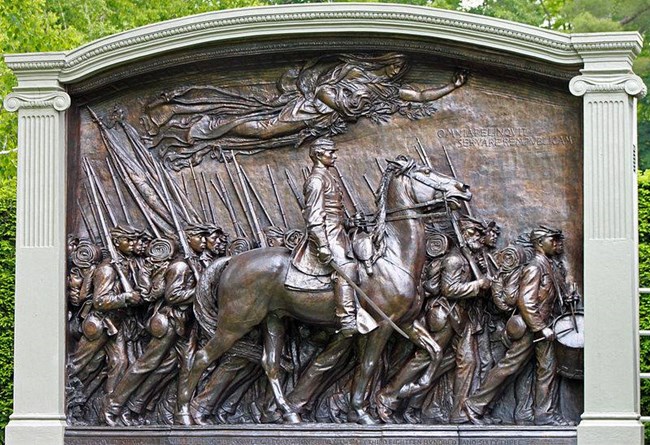
PART 1: Read this brief synopsis of COL Robert Gould Shaw’s Union Regiment’s actions at Fort Wagner. You might remember the scene as depicted in the popular 1989 movie Glory. The picture above displays a monument that represents (course theme alert!) this battle. What observations can you make about the narrative this memorial might put forth regarding Shaw and his regiment?
PART 2: Next, read Robert Lowell’s Poem “For the Union Dead” on page 1664 of your Norton Poetry Anthology. How does this poem address/represent the same monument in the poem?
PART 3: Now read the Kevin Walker Poetry selections located under the “Supplemental Materials” tab. How does your reading of Walker’s poem now engage (disrupt, enhance, undermine, enhance, parody, address, extend, etc.) the messages intended by Lowell’s Poem?
PART 4: Finally, How do Young’s other poems contextualize your understanding of “For the Confederate Dead”?
200-250 words each part; worth 20 instructor points for thoughtful responses. Due NLT Lesson 8 (3/4 FEB). **Please submit all parts as one reply** Thanks.
Read the biographical information regarding Sylvia Plath at the link below.
How does this knowledge change/enhance/disrupt your interpretation of the poem “Lady Lazareth” or its speaker?
What role does cruelty such as the holocaust imagery play in the poem?
What other images does Plath employ that are particularly meaningful or effective? (250-300 word response, due Lesson 6 (28/29 January).
Onomatopoetic words, such as the word “[b]uzz” in Dickinson’s poem, can be useful to achieve a particular aural effect; however, Alexander Pope’s “Sound and Sense” contains none. How does his poem still attain the very qualities that each line suggests? How do Pope’s allusions to classical figures (Zephyr, Ajax, Camilla, Timotheus) provide depth to his poetic demonstration? Explain how another poem from this lesson makes use of sound imagery/effects to resonate or amplify meaning. 250-300 word response, due before class, lesson 5 (24/27 January).
 en102.art.blog